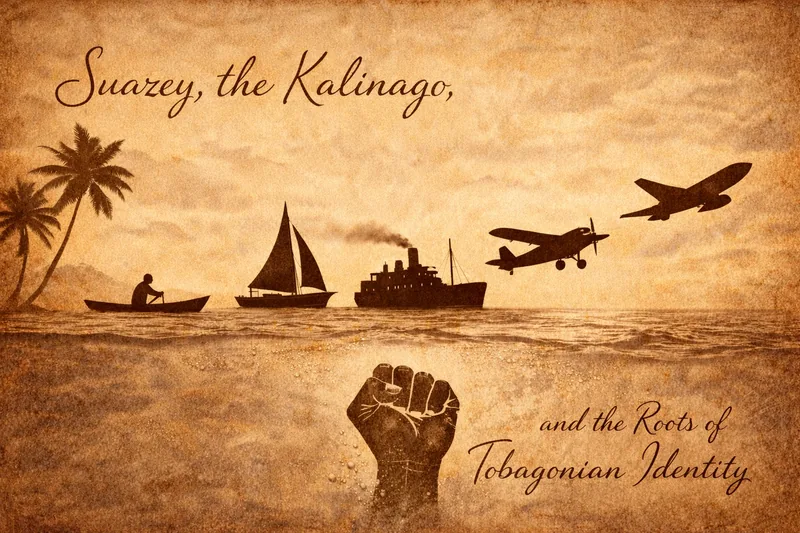
The Record and the Debate
When Europeans first reached Tobago, they described encountering Kalinago communities. Archaeologists, however, identify the pre-contact material record on the island as belonging to what they call the Suazey tradition. Whether the Suazoid people were the direct ancestors of those Kalinago communities, or whether cultural shifts occurred in the centuries before contact, remains debated.
Several possibilities linger.
The Suazoid people may have been the same population Europeans later called Kalinago. The Suazoid culture may have evolved into what Europeans encountered. Or the Suazoid population may have declined or shifted, with Kalinago groups arriving later from nearby islands.
The evidence does not settle neatly into a single narrative.
Europeans did not encounter emptiness.
They encountered a landscape shaped by centuries of organized indigenous life.
Cultural Layering Before Contact
It is important to note that the Suazoid culture did not emerge in isolation. Tobago had been inhabited for centuries before this period, including earlier Saladoid (c. 500 BCE–AD 600) and Troumassoid (c. AD 600 – 1200) communities whose ceramic traditions and settlement patterns shaped the island long before AD 1100. The Suazoid phase, dated roughly between AD 1100 and 1400, emerged from those earlier traditions and became a visibly enduring cultural presence in the centuries before European contact, even as other communities continued to exist on the island.
Over time, distinctive Suazey pottery styles transitioned into forms that would later influence Caribbean folk pottery, reflecting a movement away from ornate ceremonial display toward practical vessel forms suited to marine subsistence and inter-island exchange, long before colonial interruption.
But what scholars label as a “tradition” was once simply — LIFE.
It was the hands that shaped clay, the fires that hardened it, the villages that ate from it, and the communities that defended it.
Not just empty land or wilderness, but organized communities, trade networks, strategic warfare networks, and ritual life.
Leadership, Mobility, and the Sea
Excavations at Golden Grove in Tobago reveal something striking. Among the remains are unusually large quantities of tuna bones, suggesting a level of marine specialization rare in the wider Caribbean archaeological record. This was not accidental fishing. It was knowledge and skill: adaptation to a specific island environment.
The sea was more infrastructure than scenery.
Large dugout canoes were carved from silk cotton trees: vessels strong enough to carry people and goods between islands. These canoes facilitated trade, communication, and conflict across the Lesser Antilles.
Suazoid villages were semi-autonomous, each led by a headman known as a cayaguasu. He mediated disputes, organized communal labor, coordinated defense and warfare, and maintained ties with neighboring islands. Leadership was embedded in kinship, protection, and inter-island diplomacy. Political organization existed long before colonial governors arrived.
The Kalinago, as described in early European accounts, were fiercely independent, resistant to colonization, strategically mobile, and regionally connected. They moved between islands, traded, fought, and adapted.
That feels familiar.
Continuity and Identity
Tobago’s modern identity often carries a subtle resistance to being overshadowed. There is fierce local pride. A deep sense of autonomy within the twin island state. A memory of being fought over, administered, transferred, but never erased.
Disease, violence, enslavement, and forced migration shattered much of the pre-colonial world. But cultural memory does not operate only through bloodlines. It also lives in posture, in instinct, in how a community understands itself.
Although other cultures from distant lands were brought to Tobago’s shores, the intermingling did not erase what was already here. It layered upon it. Beneath imposed systems and new identities, something distinctly Tobagonian endured.
When Tobagonians say, “we different,” what are they really referencing?
Culture rarely disappears completely. It transforms.
Modern Tobagonians move between Trinidad and Tobago for work. They build lives in the United Kingdom, the United States, Canada, and far beyond. They settle in Europe, the Middle East, Asia, and still insist they are Tobagonian.
It is a rhythm older than the British flag.
Before the flag.
Before the fort.
There was, and remains, Tobago.
References & Further Reading
-
Drewett, P. L. Excavations at Heywoods, Barbados, and the Economic Basis of the Suazoid Period in the Lesser Antilles. Proceedings of the Prehistoric Society. Click Here
-
Hofman, C. L., & Bright, A. J. From Suazoid to Folk Pottery: Pottery Manufacturing Traditions in a Changing Social and Cultural Environment on St. Lucia. New West Indian Guide. Click Here
-
Lenik, S. Carib as a Colonial Category: Comparing Ethnohistoric and Archaeological Evidence in the Lesser Antilles. Ethnohistory. Click Here
-
Hofman, C. L., Martin, J. A., Boomert, A., & Manem, S. Reimagining Creolization: The Deep History of Cultural Interactions in the Windward Islands. Latin American Antiquity. Click Here
-
Bullen, R. P. Archaeological Chronology of Grenada. American Antiquity. Click Here
-
Steadman, D. W., & Jones, S. Long-Term Trends in Prehistoric Fishing and Hunting on Tobago, West Indies. Latin American Antiquity. Click Here