A Name Shaped by History
The name Les Coteaux is more than descriptive.
It is a reminder of Tobago's layered colonial past.
Translated from French, Les Coteaux means the hillsides, a fitting description of a village shaped by steep terrain and rolling slopes overlooking the Courland River valley.
The name dates back to the late eighteenth century, a period when Tobago changed hands among several European powers, including the French, who left a lasting mark on the island's landscape and place names. Even after British control was firmly established after the Napoleonic Wars in 1814, many of these names remained, preserved as part of the island's historical memory.
Over time, however, the name has taken on a life of its own.
In standard French, it is pronounced "Lay Koh-TOH"
In Tobago, the name has been reshaped over time.
Among residents, the pronunciation often shifts between "Les Koh-TOH" and "Leh Koh-TOH". In stronger dialect, it can take on even more distinct forms, sometimes heard as "Lek ka-TOE" or even "Leckitoe". Some note that speakers from the more urbanized southwest of the island, often referred to as "low side" or "town side" depending on perspective, are more likely to say "Leh Koh-TOH".
These variations often come from how people grew up hearing the name, rather than something they phonetically choose on purpose.
In some cases, the way it is said also carries a quiet social awareness, with speakers adjusting depending on who they are in the presence of.
While the formal French version still exists, the name has taken on a distinctly local life.
In that shift, the village carries both its colonial past and its lived identity.
A Village in the Hills
The first impression of Les Coteaux is the land itself.
The terrain is steep and rolling, sometimes described as mountainous in Tobago terms. Homes are built along the hillsides or nestled into the gullies or valleys below, and the roads wind with the land rather than cutting through it.
Agriculture remains visible across the landscape. Cassava, yams, and sweet potatoes are grown on beds, or banks, that follow the contours of the hills.
What appears picturesque is also practical, serving as a method of soil conservation.
The main road is narrow and winding, following the natural shape of the terrain and avoiding abrupt changes in elevation. This makes the movement of essential goods and services through the village navigable, as steeper, more direct routes would be difficult for vehicles to successfully traverse.
From Plantation to Village
That relationship with the land reaches back to a time when working it was not a choice, but a condition of survival.
Like much of Tobago, Les Coteaux was once the site of large and productive sugar estates. The hills that now hold homes and small farms once supported fields of cane, cultivated through the labour of enslaved Africans.
Remnants of that past remain in places like Arnos Vale, where an old water wheel and estate ruins can still be seen. Other sites, such as the Franklyn estate remain in varying states of preservation, though they are less well known and less frequently visited. But the deeper traces of that plantation history are not always visible.
Stories passed down through generations speak of massa days, a term used to describe the time of plantation slavery and the harsh realities that came with it.
There was a copper, or cupper in almost every yard: large metal pots once used in sugar processing on the estates, a reminder of the village's plantation past.
📌 Note These pots were often made of or lined with copper, allowing for even heat distribution during the boiling of cane juice.
Today, however, that past has largely receded from daily conversation. As generations pass, the distance between lived memory and inherited history continues to grow.
Where Folklore Took Root
Out of that history, however, something else endured.
Les Coteaux is widely regarded as the folklore capital of Tobago.
For many outside the village, its identity has long been tied to obeah: a system of spiritual and healing practices rooted in West African traditions that involves unseen forces believed to shape everyday life.
The village developed a reputation that was both feared and respected. Disputes involving residents were approached cautiously, shaped by a belief that those within the village had access to spiritual power through obeah, and that conflict could carry consequences beyond the physical. Even personal relationships were sometimes influenced by the sense that Les Coteaux was a place not to be taken lightly.
Any outsider looking for love in Les Coteaux was risky business.
These perceptions are rooted in deeper historical realities. The presence of large enslaved populations on the estates allowed African spiritual traditions and customs to be preserved and carried forward. Over time, these practices became woven into the cultural identity of the village.
Stories of soucouyants, Papa Bois, douens, and other spirit-like beings were shared within families, often as a way of explaining events or guiding behaviour.
Accounts of unexplained marks, such as red bruises believed to be caused by a soucouyant feeding at night, were met with familiar responses, including the use of rice to distract it, and salt as a means of personal protection, also believed to prevent the entity from changing forms.
Even as belief systems have evolved, traces of these traditions remain.
The Story of Gang Gang Sarah
Among the most well-known stories is that of Gang Gang Sarah.
The story tells of an African woman said to have used her ability to fly across the ocean to reach Tobago in search of her family, who had been taken into slavery. She remained in the village for many years, living as a healer and midwife. When she later attempted to return to Africa, she found she could no longer fly, having lost her power after consuming salt. She fell from a silk cotton tree, a moment that has come to symbolize the rupture between Africa and the Caribbean.
Often introduced to children at an early age, the story has long been part of the cultural fabric of the village. Today, it is widely understood as folklore, a body of stories and beliefs passed down through generations that once helped explain and guide everyday life, yet it still lingers in the hearts and beliefs of many.
Elements of the landscape, particularly silk cotton trees, still carry a sense of reverence tied to the story.
Keeping the Stories Alive
This connection between story and place is most visible during the Tobago Heritage Festival.
Les Coteaux's presentation, a staged performance that brings the village's folklore to life, is considered one of the highlights of the festival, drawing large crowds and showcasing its deep cultural roots. Through drama, music, and storytelling, traditions once passed down quietly within families are brought to a wider audience.
There is also a growing awareness that preserving these traditions requires continued effort, with a need to keep presentations fresh and engaging as audiences change over time.
Life in the Village, As It Was
Beyond the stories, the pleasures of everyday life were plentiful.
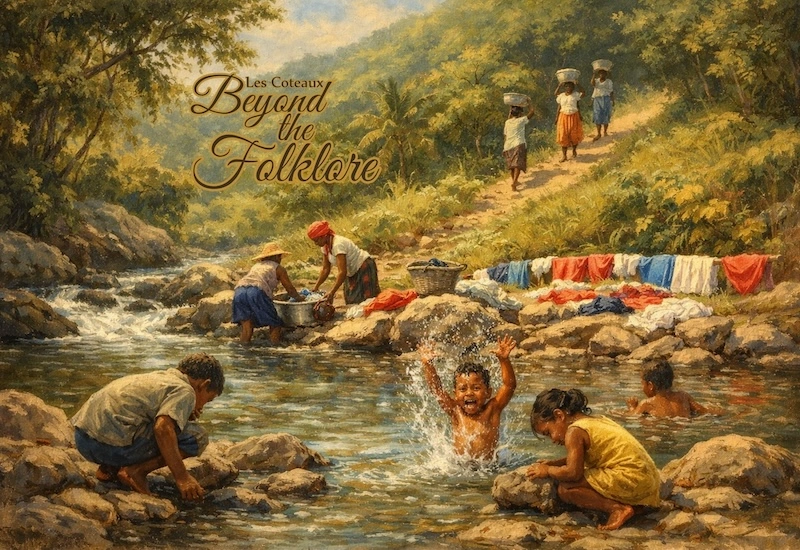
Life was simple. During the drier months, when water shortages were common, families would walk the trails to the Courland River. Laundry was washed and spread across the rocks to dry, while children searched beneath stones for crayfish and bathed in the soft river water, the kind that took time to rinse the soap away.
Along the narrow, hilly paths leading back from the river, it was common to see women balancing large tubs of laundry and water on their heads, moving steadily toward their homes. Men and women alike carried garden produce in the same way, walking through the village with the quiet rhythm of daily life.
Agriculture played a central role, with families producing ground provisions and other crops for sale in the Scarborough market. The village also developed a reputation for producing some of the finest farine in Tobago, a staple food made from cassava using traditional methods.
📌 Note Farine is made by drying and roasting grated cassava into a coarse flour, valued for its long shelf life and its ability to provide reliable nourishment. It was produced as a way to preserve cassava and create a food source that could be stored and transported over time.
Community life was reinforced through gatherings such as weddings, funerals, and especially wakes. These events brought people together through shared food, music, and collective participation, strengthening the social fabric of the village.
The Anglican church also held an important place in village life. Established in the nineteenth century, it served not only as a place of worship, but as a central space for gathering, marking key moments such as baptisms and other rites of passage. For some, it offered a sense of refuge, a space for those who chose not to engage with the village's folklore traditions, while still remaining part of the wider community.
It remains an active presence today.
There was this sense of a small, close-knit community, with a distinctly country feel. A few parlors provided basic goods, and the rhythms of daily life were shaped by both proximity and distance, with Scarborough about twenty minutes away and Plymouth closer still.
There were also familiar figures who served the needs of the entire community. Among them were characters with intriguing and mysterious names, like Shadow, the lone tailor known to everyone, whose shop along the main road served the village.
While not unique to Les Coteaux, the existence and contributions of such individuals reflected a broader village structure, where essential roles, whether tailor, butcher, shopkeeper, or tradesman, were woven into everyday life.
Village Icons
From this environment emerged one of the most distinctive and original voices in the history of Caribbean music.

Winston McGarland Bailey (4 October 1941 to 23 October 2018), known to the world as:
The Mighty Shadow
Les Coteaux profoundly shaped his music, embedding African folklore, percussion, and spiritual themes that would come to define his unique calypso style.
Some of his most celebrated works, such as Bassman (a figure rising from Hell), Pay the Devil, La Diablesse (a devil woman exposing her cowfoot), and Abyssinia (the terrifying Blue Devil masquerader), are drawn directly from the folkloric world of Les Coteaux.
Although born in Belmont, a suburb of Port of Spain, Trinidad, he was raised in Les Coteaux by his grandparents, Evlan and Elly Bailey, until he was approximately 15 or so years of age.
This formative period in the village shaped virtually every dimension of his artistic character.
In his own words, he described his childhood in the village with a deep, almost reverent attachment to the natural world:
All I know is I always liked the bush, the trees and breeze. I liked listening to the birds. I always looked at the sunset.
The mighty ShadowHe spent his days looking after cattle, sheep, and donkeys, bathing in the river, and wandering alone in the bush. His grandfather was a musician and choirmaster, and the household was filled with music.
Accounts suggest that the first music The Mighty Shadow ever heard was the sound of wooden drums covered with goatskin, heated over a coconut branch fire and accompanied by a fiddler at weddings and celebrations, a direct echo of the African percussion traditions preserved in Les Coteaux.
Recalling the first time he heard calypso at the age of eight, he said:
I was so carried away. I knew from that moment what I wanted to do with my life.
His onstage persona, the long cape, wide-brimmed hat, and oratorical style, can be seen as a nod to the West African griot tradition, suggesting a spiritual storyteller moving between the ancestral realm and the living world.
One fiddler he would have been mesmerized by was village native, and member of his extended Bailey family, Vandyke Bailey.
As one of the last of a generation of Tobago's traditional Tambrin fiddlers, Bailey carried a role that was both rare and essential.
In Tambrin music, the violin, often referred to as a fiddle, does more than provide melody; it helps establish the tempo, weaving through the drums in a way that anchors the entire ensemble.
That sound The Mighty Shadow first encountered, wooden drums tightened over fire and a fiddle moving through them, was not incidental. It was part of a living tradition, one that Vandyke Bailey helped sustain at a time when these forms were already beginning to fade from everyday village life.
Bailey belonged to a generation of musicians whose style carried the imprint of older ways of playing, before newer influences began to reshape the sound. Through his playing, the music of Les Coteaux retained its character, its rhythm, and its connection to a deeper cultural memory.
Today, that sound is increasingly rare, and his contribution remains something remembered and quietly missed.
But the village's traditions were not carried through music alone.
One of the quiet pillars of Les Coteaux, a man whose life was dedicated to preserving and living Tobago's cultural heritage, was Ulric Grant.
He became widely known for his unforgettable portrayal of the Obeah Man at the Les Coteaux Heritage Festival, bringing to life the same spiritual and folkloric world that has long defined the village. But he was also a master chef, known for preparing traditional dishes such as concote and coo-coo, and a skilled craftsman who built traditional dirt ovens, preserving practices that are as much history as they are culture.
Now passed, his presence is still deeply felt in the village.
📌 Note Concote is a traditional Tobago dish made from ground provisions slowly cooked into a thick, hearty mixture, often with coconut milk and seasoned meats or fish. Coo-coo, also a traditional dish, is made from cornmeal and ochro, cooked into a smooth, firm consistency and typically served with fish.
Born on October 31st, 1941, Grant served the community not only through formal roles, including his work with the Les Coteaux Village Council and the Les Coteaux Close Connection Heritage Group, but through the everyday work of keeping tradition alive.
Whether through performance, food, or craft, Ulric Grant embodied something deeper: a living connection to the village's past, and a steady hand ensuring that it would not be forgotten.
That same responsibility of carrying culture forward can be seen in the work of
Carion Baird-Job.
Deeply rooted in the cultural life of Les Coteaux, her work has centered on the organization, preservation, and promotion of Tobago's heritage. Through her involvement in festivals and cultural initiatives, particularly those connected to the Tobago Heritage Festival, she has helped bring the traditions of the village into wider national focus.
Her role reflects a different kind of stewardship. Not only keeping tradition alive within the community, but helping to shape how it is presented, understood, and sustained in a modern context.
In her, the culture of Les Coteaux is not only preserved, but actively carried forward.
The impact and influence these individuals have had on younger generations of Les Coteauxians is difficult to measure, but impossible to ignore.
More Than Folklore
Over time, Les Coteaux has evolved, much like other villages across Tobago.
The arrival of modern conveniences such as cable television, internet access, improved public transportation, and increased vehicle ownership has opened the village more fully to the rest of the island. Movement of people, resources, ideas, and skills is now clearly visible in everyday life.
In earlier years, families were largely sustained by agriculture. The village produced hardworking families who cultivated ground provisions, pumpkins, and other crops that were taken to market in Scarborough. While that foundation remains part of the village's identity, many have since moved beyond agriculture, taking on roles that contribute to the wider development of Tobago.
Some villagers found employment in the hotel and hospitality industry, working in areas such as Arnos Vale, Plymouth, and Black Rock. Others became schoolteachers, teaching in the village's primary school or in surrounding communities. Many were also employed in various capacities in what were commonly referred to as government jobs both within the village and in Scarborough.
Today, many continue to join the diaspora, going on to study, work, and contribute to communities beyond Tobago. From education and public service to business and the creative industries, the influence of Les Coteaux can be seen far beyond the village itself. While many remain rooted at home, others carry its values, experiences, and cultural identity with them, shaping the wider world in ways both visible and quietly enduring.
Despite this, misconceptions remain.
Because of its association with folklore, Les Coteaux is sometimes viewed as being rooted in the past. In reality, it is a modern community with ambition, with access to the same services and opportunities as other parts of Tobago.
The folklore that defines its reputation does not define its daily life or its reality.
What remains constant, however, is Les Coteaux's place within the identity of Tobago.
For many, the mention of Les Coteaux immediately brings folklore to mind. The village and its stories are closely intertwined.
Yet to understand Les Coteaux fully is to see beyond that single narrative.
It is a place where history still lingers in the land, where memory is carried across generations, and where the past continues to shape the present in quiet but lasting ways.
It is also a place that has produced voices, kept traditions, and carried culture forward, each in their own way, beyond the boundaries of the village itself.
In Les Coteaux, folklore is only part of its story.
It exists alongside history, memory, and the lived experiences of its people, all woven together into its identity.
References & Further Reading
- Caribbean Atlas. Tobago: In and Out of Colonial Empires.
- Caribbean Beat. Tobago's Hidden History.
- Charan, R. (2015). Tales of Les Coteaux. Trinidad Express.
- Hackett, Z. A. (2020). District Highlight: The Historical Ruins of Les Coteaux. Facebook.
- Newsday (2019). Les Coteaux — the Folklore Capital.
- Newsday (2023). Carion Baird-Job: The Cultural Queen of Leckitoe.
- National Archives of Trinidad and Tobago (2015). The Tobago Heritage Festival: Preserving Folk Traditions.
- History of Tobago's Heritage Festival — Les Coteaux.
- NALIS. Tobago Heritage Festival.
- Tour Tobago Travel. St. Thomas Anglican Church.
- Jacob, D. (1995). Shadow: The Uncrowned King. Caribbean Beat, Issue 16.
- Healy, D. (2018). The Man Behind the Shadow. Trinidad and Tobago Newsday.
- Wired868 (2018). Casting the Longest Shadow: How the Bassman from Les Coteaux Shook Up Calypso.
- Tobago Festivals. Keeper of Tradition, Builder of Legacy: Heart of Les Coteaux at the Heritage Calypso. Facebook.
- Meyer, J. Caribbean Folklore and Belief Systems. (PDF)