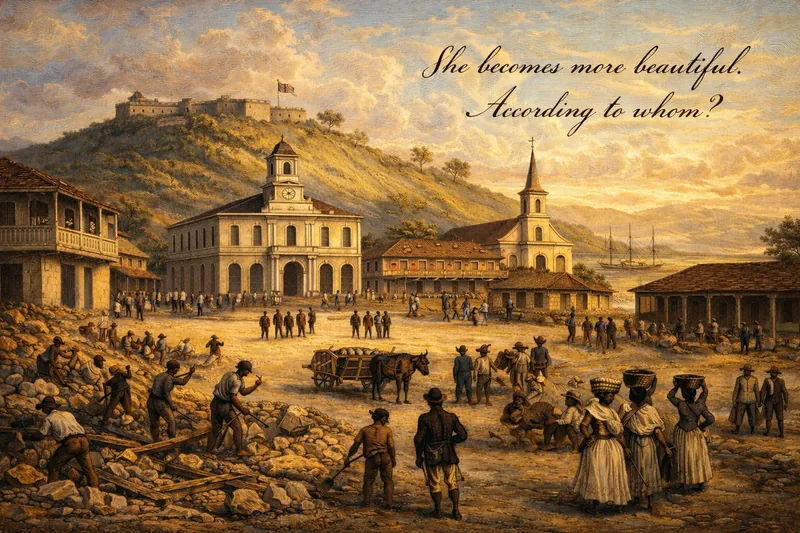
In 1816, Tobago adopted a simple Latin phrase as its civic motto: Pulchrior Evenit.
She becomes more beautiful.
At first glance, it sounds ornamental doesn’t it?
A polite inscription fit for a colonial crest. The kind of phrase one might engrave beneath a harbour view or a courthouse façade.
History rarely uses words lightly though.
The Latin is worth pausing over.
“Pulchrior” means more beautiful. “Evenit” means she turns out, she emerges, she becomes. It is not a statement of fixed beauty.
It suggests transformation. Improvement. Refinement over time.
Becoming.
In 1814*, under the Treaty of Paris that concluded the Napoleonic Wars, Tobago was formally ceded to Britain. By 1816*, British administrative control had been consolidated, governance structures reorganized, and public space in Scarborough reshaped. Buildings were cleared from the market area to create an open square. Order replaced what they considered disorder, and administration replaced local autonomy.
And in that moment of reordering, the island was declared to be becoming more beautiful.
Beautiful for whom?
To the colonial eye, beauty often meant symmetry, order, productivity and profitability. Beauty meant plantations functioning efficiently. Ports moving goods. Space cleared and regulated. The rough edges of a contested island smoothed into something governable and disciplined.
But Tobago’s story up to that point had been anything but smooth. The island had endured centuries of European rivalry. Dutch, French, Courlanders and British powers fought for control. Sugar wealth rose and fell. Hurricanes battered estates. Soil exhaustion weakened plantations. Enslaved Africans carried the economic burden of an empire that measured success in exports.
When Britain finally secured Tobago, the island was not stepping into prosperity. It was stepping into administrative consolidation.
So when the motto declared that she becomes more beautiful, it reflected a particular lens. A colonial confidence. A belief that British order was improvement. That governance equated to refinement.
Yet history has a way of revealing what slogans conceal.
Because Tobago did become more beautiful.
Not through imposed symmetry. Not through administrative tidiness. Not through imperial declarations.
She became more beautiful through endurance.
Through the cultural survival of African traditions that were never erased. Through the persistence of village life beyond plantation logic. Through music, storytelling and memories carried across generations. Through communities that rebuilt after economic collapse. Through identity that refused to dissolve.
Beauty emerged not from colonial refinement, but from resilience.
Today, the motto still stands. It appears in civic symbolism. It echoes in cultural celebrations. It has outlived the imperial system that introduced it.
And its meaning has shifted.
Now, when we say she becomes more beautiful, we are not referring to imposed order. We are speaking of growth after struggle. Of dignity after hardship. Of identity shaped by survival.
The irony is quiet but profound.
An empire once declared improvement from above. But the beauty that endures was cultivated from within.
Perhaps that is the deeper truth embedded in the Latin. Becoming is not something administered. It is something lived.
Tobago was never simply an island to be refined. She was, and remains, a living story. And every chapter of endurance adds to her beauty.
She becomes more beautiful still.
References & Further Reading
Historical Context
-
Pulchrior Evenit
Latin for “She becomes more beautiful.”
-
* 1814
Under the Treaty of Paris, Tobago was formally ceded to Britain following the Napoleonic Wars.
-
* 1816
British administrative control was consolidated. Governance structures were reorganized and public spaces in Scarborough were reshaped.
-
19th Century Economy
Tobago’s plantation economy struggled with soil exhaustion, falling sugar prices, hurricanes and the aftershocks of emancipation.