Origins and Migration Patterns
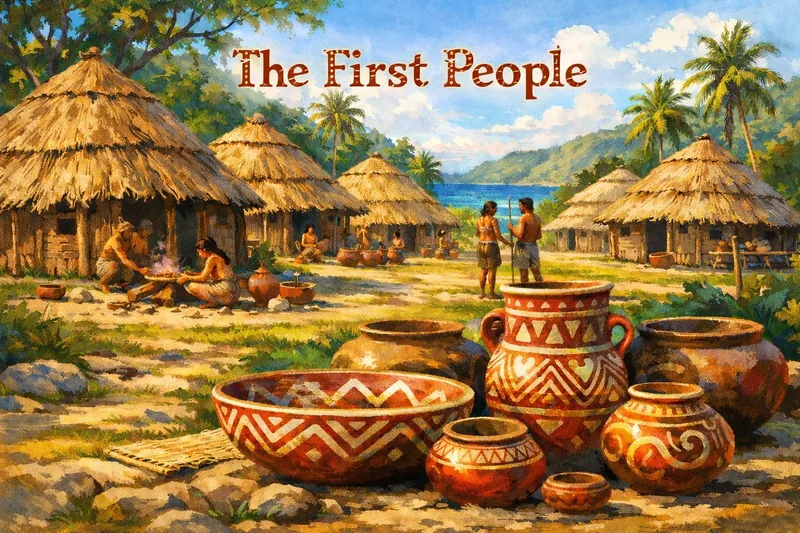
The settlement of Tobago occurred in several distinct waves, primarily originating from the Orinoco River delta in modern-day Venezuela.
| Period | Group | Characteristics |
|---|---|---|
| Archaic (c. 3500 – 1000 BC) | Ortoiroid | The earliest known inhabitants of Tobago. They were hunter-gatherers who relied on fishing, shellfish, and small game. They did not produce pottery but used stone tools and lived in small, mobile communities. |
| Ceramic (c. 250 BC – 600 AD) | Saladoid | Named after the Saladero site in Venezuela. These communities introduced agriculture, particularly cassava cultivation, and produced highly decorative white-on-red pottery. Their settlements became more permanent and regionally connected through trade networks. |
| Middle / Transitional Ceramic (c. 600 – 1000 AD) | Troumassoid | Represents a period of cultural transformation following the Saladoid tradition. Pottery styles became less ornate and more utilitarian. Settlement patterns evolved, reflecting shifts in social organization and regional interaction. This phase bridges early agricultural societies and the later Late Ceramic cultures. |
| Late Ceramic (c. 1000 AD – Contact) | Suazey / Kalinago | Associated archaeologically with the Suazey material culture and historically with the Kalinago, often described by early Europeans as “Caribs.” These communities expanded through the Lesser Antilles and were the dominant cultural presence in Tobago at the time of European arrival. |
Rather than representing isolated populations, these periods reflect overlapping waves of migration and cultural development. Movement through the southern Caribbean followed a “stepping stone” pattern from the South American coast to Trinidad, then to Tobago, and further north into the Antillean archipelago.
The island carried Indigenous names long before it was called Tobago. Some sources record Tavaco, possibly linked to a Y-shaped smoking pipe used in ritual practice. Others reference Aloubaéra or Urupaina. Within this regional network, Tobago functioned as both a strategic position and an agricultural hub.
Culture and Social Structure
Indigenous societies in Tobago were organized into autonomous villages, typically led by a chief. Among the Lokono, often referred to by Europeans as “Arawaks,” this leader was known as a cacique. Among the Kalinago, leadership structures differed but were similarly organized around recognized authority.
- Daily Life
Their economy combined conuco agriculture (mound farming), with fishing and hunting. They were skilled maritime navigators, constructing large dugout canoes capable of traveling between islands and the mainland. - Tobacco
Tobacco held a central place in their culture. It was used for recreation and in sacred rituals. The island’s modern name preserves a linguistic trace of this practice. - Social Organization
Historical accounts suggest that Lokono communities tended toward more sedentary and hierarchical structures, while Kalinago societies were often more egalitarian during peacetime but highly structured during conflict.
Spiritual Beliefs and Cosmology
The spiritual world of Tobago’s first peoples was populated by ancestral forces and spiritual beings. Their religious life was polytheistic and animistic, centered on the concept of Zemis.
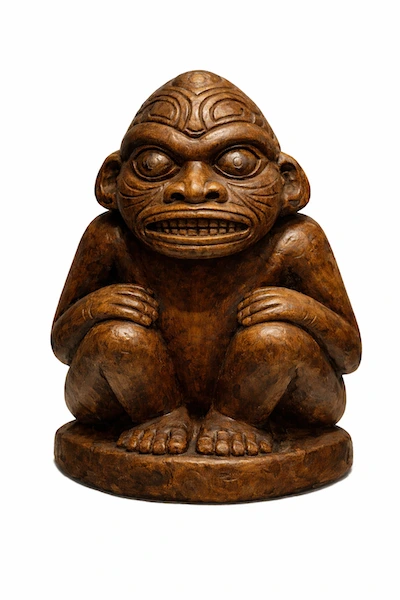
Zemis were not merely gods but physical manifestations of spiritual power, often carved from wood, stone, or bone. They were believed to influence weather, fertility, and the health of the community.
Key elements of their belief system included:
- Shamanism
The Bohique, or shaman, acted as a mediator between the physical and spiritual realms. Through the use of tobacco and hallucinogenic snuffs such as cohoba, they entered altered states to consult the spirits. - Dualism
They recognized a moral balance between benevolent forces and malevolent entities. Among the Kalinago, the feared Maybouya represented misfortune and required ritual appeasement. - Afterlife
They believed in life beyond death. The virtuous were thought to journey to a peaceful realm, while the wicked were condemned to wander.
The European Encounter and Resistance
Tobago’s Indigenous population did not disappear quietly. Unlike many other Caribbean islands where Indigenous societies were rapidly subdued, the peoples of Tobago resisted European settlement for more than two centuries.
In 1637, both British and Dutch attempts to establish permanent settlements were violently repelled. A Zeeland warship (Dutch) in 1628 reportedly lost fifty-four men in a single encounter with Tobago’s defenders.
Strategic alliances were formed when necessary. The Kalinago proved adept at leveraging European rivalries, at times aligning with French or Dutch interests to counter English expansion.
For much of the seventeenth century, Tobago was considered too dangerous for sustained European settlement. At various points it was declared neutral territory due to persistent Indigenous resistance.
The Full Arc: Decline and Extinction
The decline of Tobago’s first peoples was not the result of a single event but of compounding forces.
Epidemic Disease
Old World diseases such as smallpox, measles, and influenza proved devastating. With no natural immunity, Indigenous populations were sometimes reduced by as much as eighty to ninety percent within a generation.
Constant Warfare
As Tobago became the most fought-over island in the Caribbean, changing colonial hands thirty-three times, Indigenous communities were repeatedly caught in conflict. Raids, scorched-earth tactics, and village destruction became frequent realities.
Enslavement and Displacement
Many were captured and transported to other colonies. Some were sold into labor in places such as Barbados or Martinique. Others were sent to Trinidad or the mainland provinces of Venezuela. In some cases, Indigenous captives were absorbed into plantation systems in Suriname. Others fled to mainland South America or to Kalinago territories in Dominica and St. Vincent.
Colonial Consolidation
By the late eighteenth century, British control was firmly established. The remaining Indigenous population was gradually absorbed into the expanding society of enslaved Africans and European settlers or marginalized to the point that an independent Indigenous presence on the island effectively ended.
Legacy
While their independent political presence in Tobago ended in the eighteenth century, the legacy of the first peoples remains embedded in the island’s identity.
Archaeological sites across the island continue to yield artifacts that reflect their craftsmanship and patterns of settlement. Linguistically, the name Tobago itself stands as a permanent reminder of earlier Indigenous names and traditions.
Today, the Santa Rosa First Peoples Community in Arima, Trinidad, serves as a custodian of this heritage, representing descendants of those who survived the colonial era.
References & Further Reading
- Beckles, Hilary. Kalinago (Carib) Resistance to European Colonisation.
- National Library and Information System Authority (NALIS). Celebrating the First Peoples of Trinidad and Tobago.
- Cultural Survival Quarterly. The Indigenous People of the Caribbean.