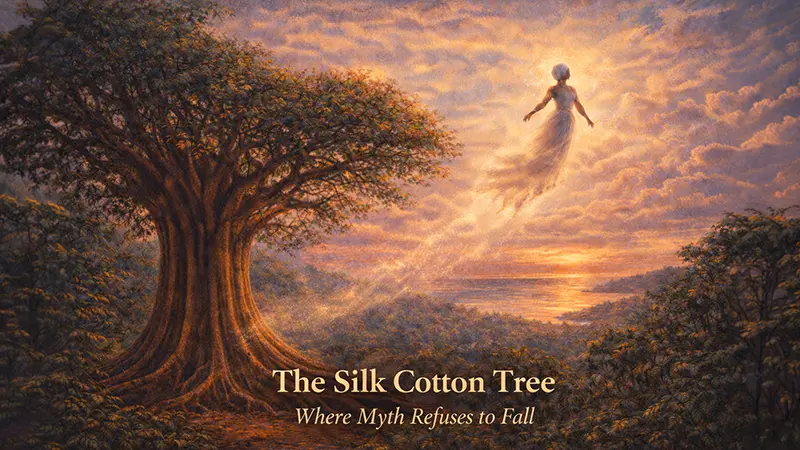
Botanical Majesty
The Silk Cotton tree is one of the giants of the Caribbean landscape. Rising 80 to 100 feet above the canopy, with trunks reaching diameters of five to eight feet, it dominates whatever space it inhabits.
Its most dramatic feature is the massive buttress roots. These plank-like extensions radiate outward from the base like the ribs of a cathedral, stabilizing the tree in shallow tropical soils. In some places, they stretch so far that they press against roads and buildings, as though quietly reclaiming the land.
The trunk is often armed with conical thorns in its younger years, and its broad crown spreads horizontally, creating an expansive canopy that hosts entire aerial ecosystems.
From its seed pods comes kapok, the silky fiber that gave the tree its common name. Light and buoyant, it was once used to fill pillows and life jackets. Its immense, workable trunk made it equally valuable: carved by the First Peoples of the Caribbean into canoes capable of crossing open water.
Ecological Powerhouse
Ecologically, the Silk Cotton is a keystone species: a plant or animal that has a disproportionately large impact on its ecosystem relative to how abundant it is.
In simple terms: If you remove it, the ecosystem changes dramatically.
📌 Note Sometimes it even collapses.
Its canopy supports dense communities of epiphytes: orchids, bromeliads, air plants. These in turn shelter birds, bats, insects, and countless unseen organisms. A single mature tree can host hundreds of micro-habitats.
It thrives in canopy gaps and regenerating forest spaces, playing an important role in forest recovery. Its sheer vertical presence makes it a structural pillar of Tobago’s forest systems.
But ecology alone does not explain the reverence.
A Tree of Spirits
Across Tobago and the wider Caribbean, the Silk Cotton tree is widely regarded as a dwelling place of spirits, duppies, and ancestral presences.
It is considered a threshold space. A boundary between worlds.
In local belief:
- Spirits reside within the hollow trunk.
- Duppies (ghosts) linger among the buttress roots.
- The tree forms a bridge between earth, heaven, and the underworld.
There remains a strong cultural taboo against cutting or trimming a Silk Cotton tree. To disturb it is believed to invite illness, misfortune, even sudden death.
In some traditions, small libations are poured at the base of the tree, often rum, as a gesture of respect to the ancestors believed to dwell there, and as a request for guidance or protection.
These beliefs are not fringe superstition.
They are inherited cosmologies that survived enslavement and colonial suppression.
Gang-Gang Sarah and the Silk Cotton of Golden Lane
A historic photograph of the Silk Cotton tree associated with the legend of Gang-Gang Sarah can be seen in this archival image shared by Patricia Bissessar.
No discussion of Tobago’s Silk Cotton tree can avoid the legend of Gang-Gang Sarah.
During the era of enslavement, the area now known as Golden Lane, within the wider Les Coteaux district of Tobago’s interior, was a sugar plantation owned by a white planter remembered in oral tradition as Grandfather Peter, or Uncle Peter in some versions of the story. His reputation, unusually, survived with a degree of favour, suggesting that his conduct toward the enslaved may have been regarded as less brutal than many of his contemporaries.
Among those enslaved on the estate were a couple named Tom and Sarah. But Sarah, the stories say, was not ordinary. She was believed to possess spiritual power. Some described her as a witch. Others as a healer or midwife.
In plantation society she was an influential presence, feared and respected in equal measure, and was believed to have carried a calling from West Africa to care for the enslaved Africans on the island.
After Tom’s death, legend tells that Sarah resolved to return to Africa.
Another version of the story holds that it was after emancipation, when Sarah believed her work among the enslaved was complete, that she attempted to fly back to Africa.
She climbed the towering Silk Cotton tree on the estate, intending to launch herself back across the Atlantic. But there was a rule in African cosmology. Those who ate salt in the New World lost the power of flight. Sarah had eaten salt. Whether she knew she had broken that spiritual law is uncertain. What is remembered is that she leapt and fell to her death from the branches of the great tree.
She was buried beside Tom in the plantation cemetery, a site that still exists.
Her grave became a place of reverence. Offerings were reportedly left there as part of Obeah practice. Nearby stood the same Silk Cotton tree from which she was said to have fallen. For many years the imposing giant bore a rough sign that read:
“This silk cotton tree was considered sacred by the African slaves who believed the spirits of their ancestors lived in its branches. Obeah men from all parts of the island came here to perform black magic rituals, the most famous being Bobby Quashie of Culloden. This tree is the largest of its kind on the island and is well known for its many legends, spanning over 150 years.”
The cemetery itself is extraordinary. It contains what are believed to be some of the only marked graves of enslaved people in the Lesser Antilles. Fifteen graves once stood there, including a more elaborate tomb dedicated to Grandfather Peter. The bricks used in their construction were imported from England as ballast in the holds of sugar ships.
Today, neglect and encroachment threaten the burial site. Homes have been built within its boundaries. Some tombs have been plastered over in well-meaning attempts at repair, obscuring their original firebrick construction. Others have been damaged entirely.
The tree and the cemetery together formed one of Tobago’s most powerful spiritual landscapes.
They hold memory, resistance, myth, and history.
All in the same soil.
Bazil and the Fear of Falling Trees
Another regional tale speaks of a devil named Bazil.
A cunning carpenter, legend says, constructed seven rooms inside the hollow trunk of a Silk Cotton tree and trapped the devil within. When an ancient Silk Cotton tree falls in rural areas, some still feel a flicker of fear. Has Bazil been released?
The story persists not because people literally expect a devil to emerge, but because the tree remains symbolically charged.
Its fall unsettles more than the landscape.
A Monumental Fall
On 2 December 2020, after hours of heavy rainfall, the historic Silk Cotton tree in Golden Lane collapsed. Its immense trunk blocked the main road (Northside Road), temporarily cutting off access to Golden Lane and the surrounding Culloden district.
Some residents later recalled that groaning sounds had been heard from the great tree for nearly two weeks beforehand.
But the obstruction of the roadway was only a small part of the impact.
For many Tobagonians, the fall of what was locally known as the “Jumbie Tree” felt symbolic: not merely the loss of wood and root, but the physical severing of a landmark tied to Gang-Gang Sarah, to Obeah memory, and to ancestral presence.
In a landscape where folklore and history intertwine, its collapse felt like a rupture.
According to some accounts, workers initially refused to cut what remained of the tree during the cleanup, wary of the spiritual repercussions that might follow.
While the grave site is officially recognized and slated for restoration, preservation efforts are now focused on maintaining the cemetery and the memory of the legend rather than the original natural monument.
Yet the tradition did not fall with it.
Other Silk Cotton trees continue to stand across Tobago, anchoring villages and forested hillsides with the same quiet authority.
In Moriah, along the main road, a towering giant often referred to as the “last Obeah tree” still rises above the roadway. Its vast buttress roots are so integrated into the hillside that they help stabilize the very road beneath it. Travelers to Castara and Parlatuvier pass beneath its shadow, aware, even if only subconsciously, that they are moving through sacred ground.
In Runnemede, another ancient tree, estimated by locals to be between two and three centuries old, stands as what many now consider Tobago’s oldest remaining Silk Cotton. Along Des Vignes Road and throughout villages such as Bacolet, Les Coteaux, Castara, and the Main Ridge, scattered giants remain.
Some carry specific legends.
Others carry only reverence.
Sacred Across Faiths
The Silk Cotton tree occupies sacred space within the Orisha faith, where it is regarded as a dwelling place of divine forces. Offerings are often placed at its roots.
Spiritual Baptists also recognize its spiritual potency.
Even within certain Hindu communities in Trinidad and Tobago, the tree is also regarded as spiritually potent, echoing associations with deities such as Kali and Bhairava, who are linked to fierce and transformative aspects of the divine.
This convergence reveals something important: Caribbean spirituality is layered. The tree became a shared sacred site across African-derived and Indian-derived traditions.
It was so central to enslaved Africans’ spiritual and communal life that British Governor Sir Thomas Picton reportedly ordered Silk Cotton trees destroyed in an effort to suppress Obeah practices and gatherings that were viewed as a threat to plantation authority.
Even the colonial powers understood what the tree meant.
A Symbol of West African Continuity
Tobago’s demographic history allowed much of its West African cultural identity to survive with unusual strength. Unlike Trinidad, Tobago experienced relatively limited post-emancipation cultural influx beyond British influence, and the population remained overwhelmingly Afro-West Indian for generations.
In that environment, African cosmology retained structural integrity.
The Silk Cotton tree became a physical anchor for that continuity.
It stood as:
- A meeting place.
- A ritual space.
- A marker of ancestral presence.
- A silent witness to resistance.
Even today, people speak of it not casually, but carefully.
Protection and Modern Threats
Recognizing its significance, Ceiba pentandra is listed under the Forests Act of Trinidad and Tobago as a species of historical, cultural, and environmental importance. This designation means the tree cannot be lawfully removed or damaged without permission, and affords it a measure of legal protection, particularly on state lands.
Yet ancient trees face pressure from development, road expansion, and urban growth. Community advocacy has often been the first line of defense.
The danger is not only ecological loss.
It is the quiet erosion of cultural memory.
More Than a Tree
The Silk Cotton tree represents resilience.
It has survived colonialism, enslavement, attempted spiritual erasure, hurricanes, and development. It continues to dominate skylines and imaginations.
It is both biological organism and cultural monument.
To protect it is not simply environmental policy.
It is preservation of Tobago’s spiritual grammar.
In a place where history was often written by others, the Silk Cotton tree remains one of the few storytellers that cannot be edited.
References & Further Reading
Florida Museum – Caribbean Archaeology Program
Plants of the World Online – Ceiba pentandra
USDA Forest Service – Ceiba, Kapok, Silk Cotton Tree
FAOLEX – Forests Act of Trinidad and Tobago
Trinidad Guardian – Trini Tree Climbers and Folklore
Rita Pemberton – The Silk Cotton Tree in the Culture of Tobago
Uncommon Caribbean – Beware The Mystical Silk Cotton Tree
Caribbean Compass – Look Out For: Ceiba, Kapok, or Silk Cotton