The Weight of a Quiet Crisis
Across the Caribbean, hypertension, diabetes, heart disease, and kidney failure have become so common that many families almost expect them as part of aging.
Yet long before anyone understood sodium levels or blood pressure, Caribbean folklore was already telling stories about salt.
Stories That Remember
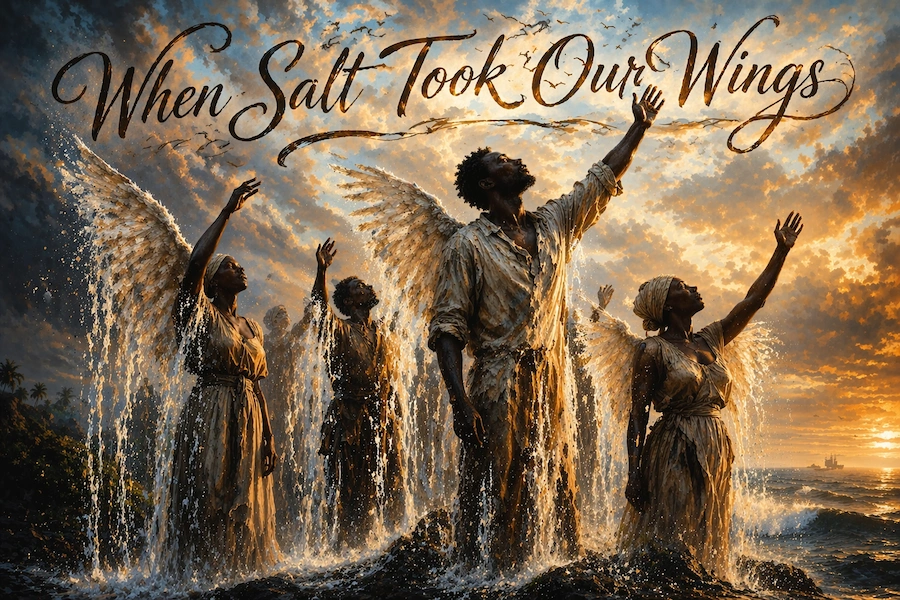
In the Tobagonian legend of Gang-Gang Sarah, an African woman brought to the island possessed the power to fly. But after eating salt on the plantation, she and others like her lost that ability forever.
Versions of this idea appear across the African diaspora.
In Jamaican oral traditions, salt is not just seasoning but something spiritually potent, capable of grounding, protecting, or driving away spirits, or duppies.
In the “Flying Africans” stories of the Gullah Geechee communities of the American Southeast, enslaved Africans were also said to have lost the ability to fly home after eating salt in the New World.
Scholars tracing the “Flying Africans” motif suggest that the warning against eating salt reflects a deeper Central and West-Central African spiritual inheritance, one that was carried across the Atlantic and reshaped under slavery.
Across oceans and islands shaped by the same system of slavery, the symbolism repeats.
Salt marks the moment when spiritual freedom gives way to the physical reality of plantation life.
It sits at the meeting point of the material and symbolic.
More Than Seasoning
In these traditions, salt is not merely a kitchen ingredient.
It is a boundary.
It grounds, binds, protects, and, in some stories, prevents return to Africa…
…to a life that existed before captivity.
It marks the moment when a person is no longer untouched by captivity, when the body becomes fixed in a new world that cannot be escaped.
As a child in Trinidad, I remember seeing that deeper meaning of salt play out in real time.
My maternal grandmother, a Spiritual/Shango Baptist and someone many in the village considered an Obeah woman, was once confronted by a crapaud (large frog) in the doorway of her home. She stopped, turned, and without hesitation went into the kitchen, returned with salt, and threw it onto the animal while repeating words I was too young to understand.
The crapaud fled the doorway in a frantic burst, disappearing as quickly as it had come.
Not long after, it was said that another woman in the village had died suddenly.
I was told that the crapaud had not been just an animal, but something sent with intention, and that whatever had been meant for my grandmother had been turned back.
I was six or seven at the time, too young to make sense of it fully. Whether what I was told was true is difficult to say.
But I saw enough in those moments, and in other things I could not easily explain when I was around her, to understand that in the world I was growing up in, salt was never just salt.
The Reality Behind the Myth
Moments like that blur the line between story and lived experience.
The symbolism becomes more striking when placed beside the historical record.
During slavery, salt was not optional: it was essential.
Plantation rations commonly included salted fish and salted meat: cheap, durable foods that could survive long sea voyages and tropical storage.
These foods were often lower-value cuts or preserved imports, while higher-value cuts were reserved by plantation owners and traders for sale or their own consumption, leaving what was inexpensive and durable to be distributed in bulk to enslaved populations.
Alongside these were cornmeal and plantains, while enslaved people cultivated root crops and greens in provision grounds, small plots of land used to grow food to supplement what they were given, including what would later be known as ground provisions such as yams, cassava, sweet potatoes, eddoes, and dasheen.
Methods like salting, drying, smoking, and brining were more than culinary preference…
…they were essential to preserving fish and meat in a world without refrigeration.
When Survival Became Tradition
Over time, those survival foods became tradition.
Saltfish, salt mackerel, pig tail, and other preserved meats and cuts such as pig ears, snout, feet, and cow heel became part of everyday cooking, family gatherings, and national identity.
In some circles, it is said that you have not lived until you have had cow heel soup on a Saturday.
They became part of how the Caribbean tastes, remembers, and celebrates.
Even our most familiar snacks carried salt.
As a child, I remember buying salt prunes during primary school recess from a vendor at the school gate. There was never anyone telling me to slow down, never any sense that too much might matter.
Between replacing the pitching marbles I kept losing in battles and buying salt prunes, I’m not sure which I spent more on with that particular vendor.
By secondary school, the ritual had deepened. I would rush home, take a piece of foil, pour out salt, crush bird peppers into it, and climb into the governor plum tree in our yard. There, it became a quiet ceremony of dip and eat.

Fruit chow, fresh fruit seasoned with salt, hot pepper, and herbs, was a constant, whether it was plum, pommecythere, mango, or whatever was in season.
Souse, a tangy pickled dish often made with pig feet or other such cuts once considered less desirable, was another favourite.
I remember once carrying salt in my school shirt pocket all day, planning ahead for a cashew tree I passed on the way home. I had spotted fruits hanging just low enough over the fence of the property to reach.
I dipped them into the salt in my pocket, not knowing the juice would permanently stain the fabric.
I lost a school shirt that day.
My folks were not amused.
I never tried it again.
Looking back, it is striking how natural it all felt. Salt was not something added occasionally. It was woven into taste, habit, and memory from an early age.
That is what makes this story complicated.
These foods speak to resilience and ingenuity under brutal conditions. But they also carry the imprint of the conditions that created them.
Honour the history, but do not romanticize the harm.
The Body Remembers
The old stories did not speak in the language of sodium, stroke, or kidney disease.
But the stories spoke of salt, and the body still carries its effects.
Today, excess sodium is one of the clearest modifiable drivers of hypertension across the Caribbean. Patterns of high sodium combined with low potassium intake remain common. The Pan American Health Organization (PAHO) reported in 2025 that salt consumption in the region is roughly double recommended levels.
Global guidelines recommend less than 5 grams of salt per day, yet agencies such as PAHO and the Caribbean Public Health Agency (CPHA) estimate that typical intake across the Caribbean falls between 9 and 12 grams.
Studies in Jamaica reflect this clearly, with most adults consuming high levels of sodium alongside low levels of potassium, a combination known to raise blood pressure at the population level.
Sodium is not the only cause of hypertension, but reducing it remains one of the clearest and most effective interventions available.
At the same time, the region faces a heavy burden of overlapping non-communicable diseases: hypertension, stroke, heart disease, chronic kidney disease, obesity, and type 2 diabetes.
Across Latin America and the Caribbean, hypertension affects roughly one in three adults between the ages of 30 and 79, with major gaps in diagnosis and control. In West Africa, where many enslaved Africans were taken from, rates are generally lower and vary by country and by urban or rural setting.
That contrast matters.
Populations with shared ancestry are experiencing very different outcomes. Studies consistently show a gradient in these patterns: rates of hypertension, diabetes, and obesity are generally lower in West Africa, higher in the Caribbean, and often highest among African-descended populations in North America.
This suggests that while history plays a role, it is not the whole story.
The environments people live in, the foods they eat, and the systems that shape both are driving these differences.
Not One Cause, But Many
It would be easy to draw a straight line from slavery to modern illness, but the reality is more complex.
There is no single cause.
The Caribbean’s health profile reflects a convergence of forces.
The plantation system helped establish both dietary patterns and cultural preferences around salt-preserved foods.
But the modern crisis has been accelerated by urbanization, reduced physical activity, rising obesity, chronic stress linked to social and economic pressures, gaps in healthcare access, and a dramatic shift in the food environment.
These forces do not act alone. They overlap and reinforce one another.
A New Food Landscape
If plantation salt laid the foundation, modern food systems have built upon it.
The sodium burden in the Caribbean no longer comes only from saltfish or preserved meats. It now comes from breads, condiments, restaurant foods, seasoning mixes, processed meats, and imported packaged products layered on top of older habits and traditions shaped by salt.
What was once a survival diet has been reshaped by globalization into something far more constant and far more difficult to regulate.
Convenience has become a central part of that shift.
In many households, both parents now work, leaving less time for the sourcing and preparation of foods that depend on access to fresh ingredients and the time to prepare meals from scratch.
In others, a single parent carries the full weight of time, income, and care, leaving little room for meal planning and preparation, and making quick, accessible options not just appealing, but necessary.
At the same time, the social structures that once supported food preparation have changed. Extended family networks, shared cooking, and the kind of “village” support that once distributed the work of daily life are less consistent than they once were.
In that context, processed and ready-made foods are not simply a preference...
...they are often the most practical response to modern life.
The Question of Inheritance
There is also the long-discussed idea that the conditions of the Middle Passage and plantation life may have favoured individuals who retained salt more efficiently, increasing the risk of hypertension in their descendants.
Today, this theory is generally treated as historically interesting but medically unproven and too simplistic.
Modern reviews have been critical of it, pointing to weak evidence, speculative assumptions, and the risk of distracting from the very real drivers of hypertension such as diet, inequality, stress, and gaps in healthcare.
It is not the explanation physicians rely on in everyday practice.
The more urgent question is not what the past may have done to the body, but how the present continues to shape it.
Culture Is Not the Enemy
Framing the issue as a conflict between culture and health misses the point.
Caribbean cuisine has never been static. It has always adapted.
Its identity does not live solely in salt, but in flavour, technique, and tradition.
It lives in thyme and scallion, in pimento and garlic, in ginger, Scotch bonnet, citrus, coconut, smoke, and texture.
It lives in how food is prepared, shared, and understood.
Cultural identity should not be defined by sodium concentration…
…though it is often treated as if it is.
Holding On, Letting Go
The path forward is not abandonment, but adjustment.
It can mean desalting saltfish more thoroughly, using salted meats more as flavouring than as the center of a dish, and shifting seasoning away from salt-heavy blends toward herbs, spices, and fresh ingredients.
It can mean reducing reliance on bouillon cubes, bottled sauces, and processed foods, while rebuilding meals around ground provisions, legumes, vegetables, and fruit.
In many ways, this shift echoes older ideas already present in the region.
In Rastafarian tradition, the concept of Ital emphasizes food that is natural, minimally processed, and balanced, prepared in a way that nourishes both the body and the spirit. It often limits or avoids salt, processed ingredients, and artificial additives, favouring fresh, natural foods prepared in ways that respect their inherent qualities and reflect an awareness of their effect on the body.
These are not departures from tradition, but choices about which traditions we choose to carry forward.
When Salt Took Our Wings
Perhaps that is what the old stories were trying to say all along. Not in the language of medicine, but in the language of image and warning.
Salt, in these stories, takes away flight.
It binds the body to a world of hardship and survival.
Centuries later, the Caribbean is still living with that inheritance.
Our foods carry memory, survival, resilience, and love.
The conditions that created some of them, however, are not conditions that need to be preserved inside the body.
✍️ Contributor Dr. Ashleigh Yeates is a Jamaican anesthesiologist and critical care specialist. She earned her medical degree at the University of the West Indies, where she also completed her residency. She currently practices at Princess Margaret Hospital in Morant Bay, St. Thomas, Jamaica. Her work focuses on acute care and patient safety, while she remains keenly interested in the broader health challenges facing Caribbean populations. She is also my cousin, someone I have long admired, and whose insight helped shape this work.
References & Further Reading
- Pan American Health Organization (PAHO). Salt Reduction in the Americas: Policy Briefs and Regional Data
- Caribbean Public Health Agency (CARPHA). Non-Communicable Diseases and Risk Factors in the Caribbean.
- World Health Organization (WHO). Guideline: Sodium Intake for Adults and Children.
- World Health Organization (WHO). Hypertension Fact Sheets and Global Health Estimates.
- Addo, J., Smeeth, L., & Leon, D. A. (2007). Hypertension in sub-Saharan Africa: A systematic review.
- Ferguson, T. S. et al. (2018). Chronic non-communicable diseases in Jamaica: Past, present, and future trends.
- Bilby, Kenneth. True-Born Maroons.
- Jamaica Gleaner. “High rate of diabetes and hypertension in Caribbean linked to history of slavery.”
- Jamaica Observer. “Salt: Cultural symbol or health risk?” (2025)