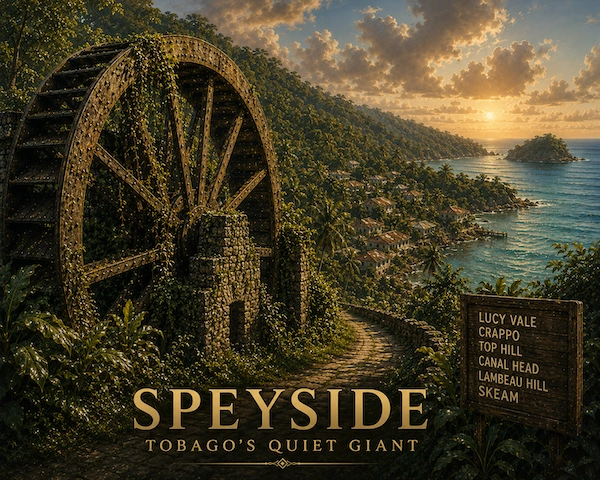
The name Speyside is not unique to Tobago.

In Scotland, it refers to a region shaped by the River Spey, known for its whisky, its landscape, and its reputation. It is often called the heart of Scotch whiskey production, home to more than fifty distilleries, including well-known names such as Glenfiddich, Macallan, and Glenlivet.
That name, like many others across Tobago, carries a broader history.
It was brought across the Atlantic during the plantation era, when British control of the island opened the door to European estate ownership. Irish and Scots were part of that colonial network, arriving as planters, estate managers, and merchants.
As they settled into the landscape, they carried familiar names with them, using those names to imprint pieces of home onto land that already had its own history.
At the same time, that influence extended to people, and can still be traced across Tobago in the surnames of many residents, passed down through generations from ancestors who adopted or were assigned the names of plantation owners.
In many cases, those names carry their own stories.
The name Yeates, for example, is said to trace back to an Irish magistrate once stationed on the island, a reminder of how closely these histories are tied to the present.
Other names such as Campbell, McPherson, Denoon, Davidson, and Alexander continue to appear across Tobago, reflecting the legacy of Scottish estate ownership.
In Tobago, Speyside grew out of five estates — Trois Rivières, Speyside, Batteau Bay, Belmont, and Murchiston — each part of a plantation system that shaped how people lived, worked, and moved across the land. Set along the waters of Tyrrel’s Bay, the area also became a point of movement, where goods from surrounding estates passed through on their way to wider colonial markets by sea.
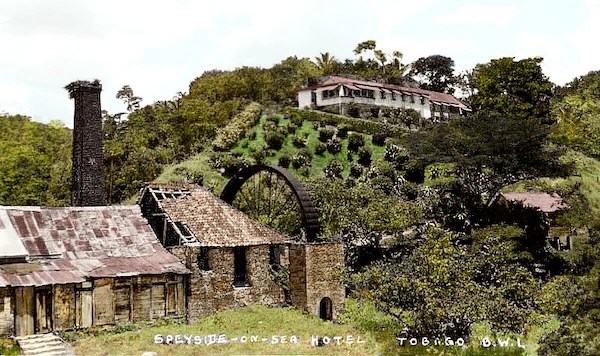
Remnants of that era still stand, including the massive iron waterwheel at Speyside Estate, one of the most recognizable plantation-era artifacts on Tobago’s windward coast.
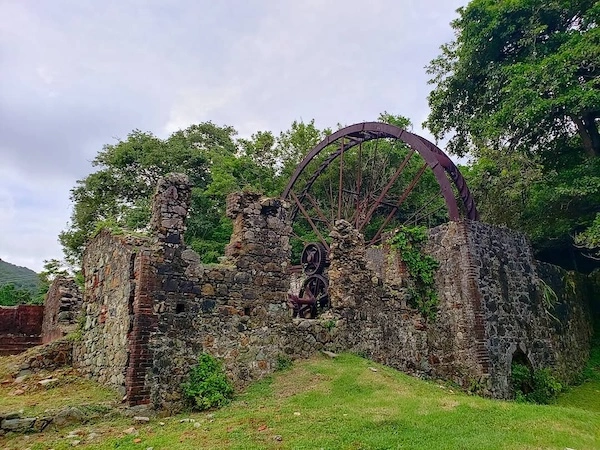
Some accounts suggest that an earlier estate wheel associated with a John Piggot existed in the late eighteenth century, while others maintain that the present iron wheel was imported from Scotland in 1834 to power the crushing of sugar cane.
Regardless of its exact origins, the structure remains a lasting symbol of Tobago’s sugar plantation economy and colonial past.
Over time, those estates gave way to a village made up of five distinct settlements: Lambeau Hill, Canal Head, Top Hill, Crappo, and Lucy Vale, each shaped by former estate boundaries and the surrounding topography, and each with its own story to tell.
Crappo, for example, is named as such because of the presence of a surprisingly high population of large frogs locally referred to as crapaud (French for toad).
A competing narrative, preserved through oral tradition, offers a different origin.
Some say the area was once known as Pay Site, a place associated with the distribution of wages or payments during the estate era. Over time, the story suggests, the name evolved into Speyside.
While this version is not supported by documented historical records, it continues to circulate within the community, reflecting how memory and meaning can shape a place just as much as written history.
📌 Note A government-established housing development during the latter part of the twentieth century created a new settlement within the village officially referred to as a Housing Scheme, but generally known by residents simply as Scheme or, in local parlance, Skeam.
A Tale of Two Sisters
Not all the stories that shape Speyside are found in records.
Some live in memory, passed down and retold over generations.
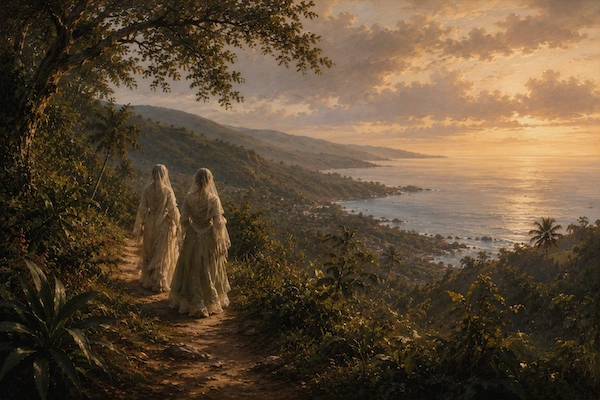
One such story speaks of two sisters, Lucy and Charlotte, of Kurgan (modern Russia/Ukraine) ancestry, remembered as figures of influence in the area.
Lucy, said to be quite adept at numbers and bookkeeping, lived in what was then called Pay Side, a name understood as a variation of Pay Site, shaped by differences in pronunciation and accent. Her sister Charlotte, it is claimed, lived further north along the coast, “just over the hill”.
They were the wives of estate owners and figures of authority within the plantation system. In the telling, they wore veils that covered their faces, and were mocked by those around them, including slaves, with those coverings becoming central to how they were remembered.
“Lucy’s veil” became Lucy Vale, the name of a small community within Speyside once associated with the production of copra (dried coconut meat used to make coconut oil) and cocoa. There is also Lucy Vale Bay along the same stretch of coast.
“Charlotte’s veil” became Charlotteville, the area to the north where Charlotte is said to have resided.
Local lore suggests that the veils were worn as a mark of extreme modesty and social seclusion. In some versions of the story, the women were deliberately kept “veiled” from the wider public, reinforcing an air of Victorian-era mystery, refinement, and class separation.
Other retellings suggest the veils were connected to a prolonged period of mourning that gradually became part of their public identity.
Over time, these stories became woven into the history and folklore of the area, contributing to the naming of Lucy Vale as a place associated with quiet beauty, isolation, and lingering mystery.
Their presence, whether rooted in history or shaped through memory, is remembered as having left an indelible imprint on the identities of both villages.
Fortune and Panchoo
While some of Speyside’s stories have faded into obscurity, others are carried in the lives of people who once moved through the village, leaving behind impressions that still shape its memory today.
Among those remembered are Fortune and Panchoo, two figures whose names continue to surface in conversations about the village, not as part of formal history, but as part of its lived experience.
Fortune was a runaway slave who lived for years in a cave overlooking Lucy Vale Bay, surviving on his own while avoiding capture. He would emerge only when necessary in search of food and water, aware that he was being tracked by slave masters.
When slavery was finally abolished in 1838, word eventually reached the village, and people went to the cave to tell Fortune that he was free.
He did not believe them, thinking it was a trick, and remained where he was, unwilling to trust the news.
Supposedly, it was only after a beautiful woman was sent to persuade him that he finally emerged from hiding.
Realizing that freedom had truly come, he is said to have begun singing:
Freedom come oh, freedom come, thank you for freedom, freedom come!
Oral tradition suggests that the cave where he lived was known to villagers as Fortune Cave, though whether it was a true cave or merely a sheltered hollow within the hillside remains open to interpretation.
Panchoo’s story, sometimes rendered in oral accounts as Pancho or Panzoo, reaches further back into a history shaped by displacement and survival, and rooted in African heritage.
He was also known as William Campbell, a Liberated African who came to reside in Speyside until his death in 1938. He is said to have come from the Moko people, also known as the Ibibio, from the region of Calabar near the Niger Delta.
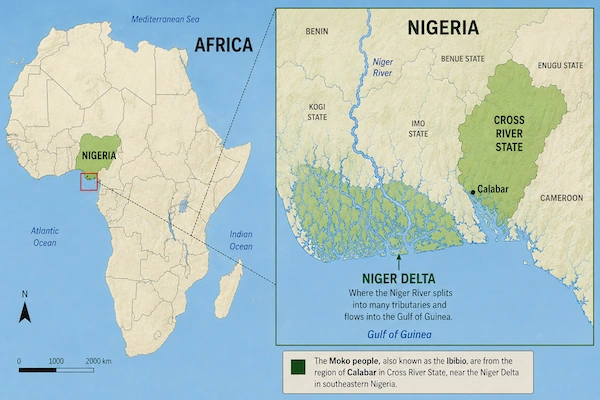
As the story is told, he had been captured by Portuguese slavers at the age of twenty-six and branded on the chest with the number “5”, a mark he carried for the rest of his life.
After the vessel transporting him was intercepted, he was freed and eventually brought to Tobago. He later adopted the name Campbell from a man who had given him shelter and shown him kindness.
Over time, he became an independent farmer, owning land, cultivating cocoa and coconuts, and establishing a life for himself in the village.
He is said to have lived well past a hundred years, with some accounts placing his age at around one hundred and seven.
He is remembered as one of the last surviving Liberated Africans in the area, his presence serving as tangible evidence of the journey endured by enslaved Africans from West Africa to the Caribbean, and from bondage to independence.
Panchoo’s descendants are still known within the village today, with families such as the Campbells and Grays identifying him as a common ancestor through oral and family history passed down across generations.
📌 Note The term “Liberated African” refers to individuals freed from slave ships after interception, often by British patrols following the abolition of the slave trade in 1807. This was separate from the abolition of slavery itself, which was legally enacted in 1834. However, formerly enslaved people were still required to work for their former enslavers under a compulsory “Apprenticeship” system until full emancipation was finally granted in 1838. Many Liberated Africans were not returned to their homelands, instead establishing new lives in places such as Tobago.
A Village Remembered
Speyside is not only shaped by its past, but by the memories of those who grew up within it.
For some, it is more than a place.
It is home in the fullest sense of the word.
Childhood in the village was marked by a kind of freedom that feels distant today, a time when July and August holidays brought long days that stretched from morning chores to evenings reluctantly surrendered to the glow of street lights, the final signal that another day of adventure had come to an end, and that anyone still outside risked returning home to the full wrath of worried parents.
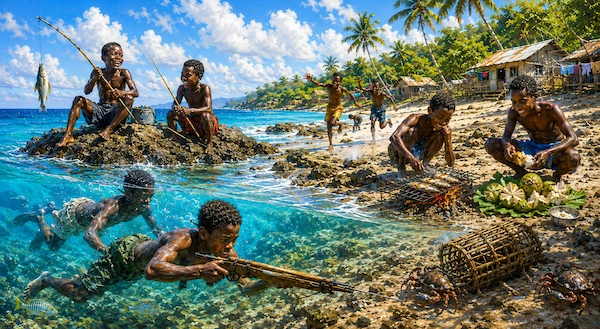
Days were spent fishing from the rocks with handmade rods crafted from bamboo, nylon, and cheap hooks, with catches roasted on the beach or taken home to be cooked. Sometimes breadfruit was taken along and roasted by the shore, paired with butter quietly taken from the kitchen. Beneath the surface of the sea, homemade spear guns were used during free dives, and on land, traps and snares were set for doves, manicou, and other wild game. Crab traps made from bamboo were used for catching crabs not only for household culinary enjoyment but also for sale, including to members of the public and Blue Waters Inn.
Play was just as much a part of that rhythm.
Games such as small goal football and windball cricket sharpened skill and competitiveness, particularly in cricket, where a format known as “Out-ah-man” meant each person was responsible for their own wicket unless aligned with a sibling.
Rivalries with neighbouring villages, especially Charlotteville, were fierce and became a major source of pride and competition.
Even daily chores carried their own lessons.

Making a fex or cocoyea broom meant gathering branches from coconut and guava trees that once stood where the Speyside High School now sits, with guavas in season often turned into jam.
The rhythms of the village were closely tied to the sea.
Fishing was not just an occupation, but a way of life, visible in everything from net mending to boat building, and even in the sound of conch shells blown to signal the return of fishermen with their catch.
Country Bookie
At the same time, Speyside carried an identity that was not always understood by outsiders.
The term “country bookie” was often used by residents from the more urbanized parts of Tobago to describe people from villages such as Speyside, Charlotteville, and L’Anse Fourmi.
Though frequently intended as mockery, with undertones that rural villagers were unsophisticated or “from the bush”, the label reflected deeper social and cultural divisions within the island.
What was often being judged was not simply where people came from, but how they spoke.
The dialect of Tobago’s northeast carries its own cadence, rhythm, and delivery, sometimes described as “broad” or “heavy”, preserving older linguistic patterns and expressions that differ from speech in more urbanized communities.
Such judgments reflected a wilful misunderstanding of the richness and variation within the language itself, as well as an apparent preference for what was considered the “Queen’s English”.
While there were many similarities with speech elsewhere in Tobago, the patterns of expression in the countryside differed enough to reinforce the perception that difference implied deficiency.
Even within Speyside itself, subtle distinctions existed between different parts of the village.
Residents of Lucy Vale, separated geographically from the rest of the community, were sometimes viewed as having “ah way about themselves”, a reflection of how closely identity, personality, and place could become intertwined within small village life.
Though often shared jokingly, such perceptions formed part of the quiet social fabric of the community.
Over time, however, the meaning of “country bookie” began to shift.
For many, the phrase became less an insult and more a marker of identity, associated with being grounded, possessing “land sense”, and speaking in a way that reflected continuity with older village traditions and ancestral forms of expression.
Though tourism has brought new opportunities, from employment in hospitality to tour guiding and small business ventures, the village has largely maintained its own sense of identity.
Its language, rhythms, traditions, and even its small internal distinctions continue to shape daily life in ways outsiders may never fully understand.
Two Names, One Bay
The coastline along Speyside, Tobago, is associated with several closely connected bays, including Tyrrel’s Bay/Speyside Bay, Batteaux Bay, Indian Bay, and smaller inlets such as Lover’s Bay.
Collectively, they form part of the sheltered northeastern coastline that helped shape the village’s maritime and tourism identity over generations.
Among these names, however, Tyrrel’s Bay (sometimes spelled Tyrrell’s Bay) and Speyside Bay have carried particular historical and cultural significance, reflecting different layers of Tobago’s colonial, military, and social history.
The original and historically official name is Tyrrel’s Bay, named in the mid-18th century after Richard Tyrrell (1716–1766), a prominent Irish officer in the British Royal Navy.
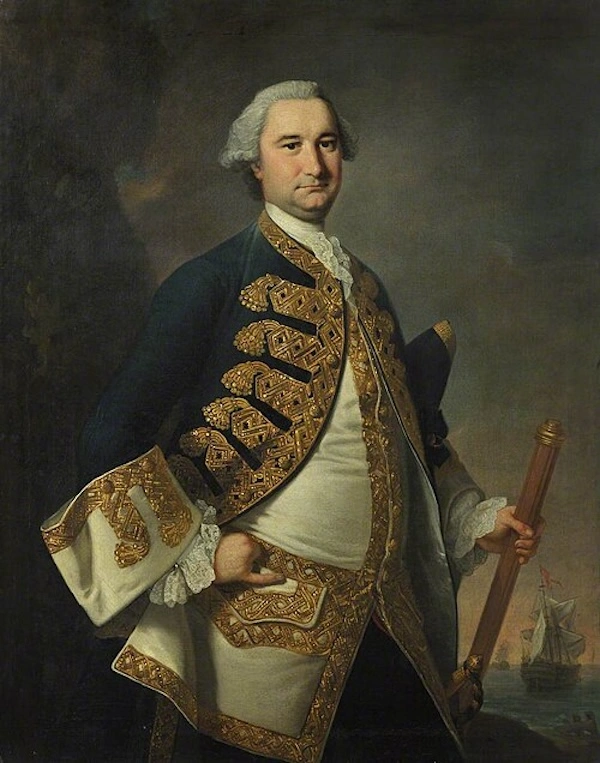
Tyrrell is remembered in Tobagonian history for his role in 1748, when he helped thwart a French attempt to seize Tobago. Commanding a British frigate, he used both naval skill and forceful presence to defend British interests around the island during a period of intense rivalry between European powers in the Caribbean.
Tyrrell’s career continued to rise after his actions in Tobago. He later became Commander-in-Chief of the British fleet in the Leeward Islands and was honoured with a large monument in Westminster Abbey commemorating his naval achievements in the Caribbean.
After the Treaty of Paris in 1763, when Tobago was formally ceded to Great Britain, British authorities began a systematic survey and division of the island into parishes and estates.
During this period, British cartographers and naval surveyors officially recorded the name “Tyrrel’s Bay” on maritime charts and land surveys, helping establish it as the formal geographical name of the area.
The naming of the bay served as a lasting tribute to Tyrrell’s defence of Tobago during this volatile colonial era.
The alternative name, Speyside Bay, emerged much later.
Its use became increasingly common in the early 20th century as the district transitioned from a plantation economy to a tourism-based one.
As the village of Speyside grew in prominence and became more recognizable to visitors, the bay gradually began taking on the name of the community along its shores.
Today, both names continue to be used interchangeably.
Tyrrel’s Bay is more commonly associated with historical, geographical, and nautical references, while Speyside Bay is often used in tourism and local community descriptions.
📌 Note Interestingly, Admiral Tyrrell was not only a naval officer but also a prominent Caribbean landowner. He owned an estate in Antigua which he renamed “Tyrrell’s”, further cementing his name within the official nomenclature of the British West Indies.
The Birth of Tobago’s Tourism
Photogenically tucked between Speyside Bay and the Main Ridge Forest along Tobago’s windward coast, Speyside emerged as the earliest center of tourism development in Tobago.
Long before the island became internationally known for boat-based scuba diving and eco-tourism, visitors were already being drawn to the district’s reefs, forests, birdlife, and dramatic coastline.
The story began on the old Speyside Estate, lands associated with English-born naturalist William Sanger Tucker during the nineteenth century.
Originally part of Tobago’s plantation landscape, the estate reflected the agricultural economy that once shaped much of the island. Remnants of that earlier era, including the historic Speyside waterwheel and the stone ruins of the old boiling house where sugar was once processed, still survive as reminders of the estate’s colonial past.
As plantation agriculture declined during the nineteenth and early twentieth centuries, particularly following a devastating hurricane in 1847, the estate gradually evolved into something very different.
An Englishman identified as Mr. Guinness later acquired the property and converted the old plantation Great House above the waterwheel into what became known as the Bird of Paradise Inn, widely regarded as Tobago’s first hotel.
Its proximity to Little Tobago, famous for its birdlife and the introduced Birds of Paradise, made the hotel especially popular among birdwatchers, naturalists, and adventurous travelers seeking the island’s remote beauty.
The hotel became known for its panoramic dining views overlooking Batteaux Bay and Little Tobago. Vintage postcards from the early-to-mid twentieth century also referred to the property as the Speyside on the Sea Hotel, suggesting that the estate and its tourism facilities operated under multiple names during different periods of ownership and development.
The tourism history of Batteaux Bay, however, is not remembered through a single clear narrative.
Surviving records and village recollections instead reveal a layered history of overlapping properties, changing ownerships, evolving hotel names, and tourism ventures that became intertwined over several decades.
Some residents distinguished between the Bird of Paradise Inn associated with the Lau estate and the neighbouring Tucker family property that later evolved into what is today known as Blue Waters Inn. According to these accounts, the larger Lau estate stood uphill above the historic waterwheel and was separated from the Tucker property by the road leading toward Belmont.
Villagers also recalled a small beachfront facility near a secluded cove cheekily referred to as Lover’s Bay, located a stone’s throw away from the hilltop inn, where guests reportedly stored equipment and prepared for boat excursions and seaside activities.
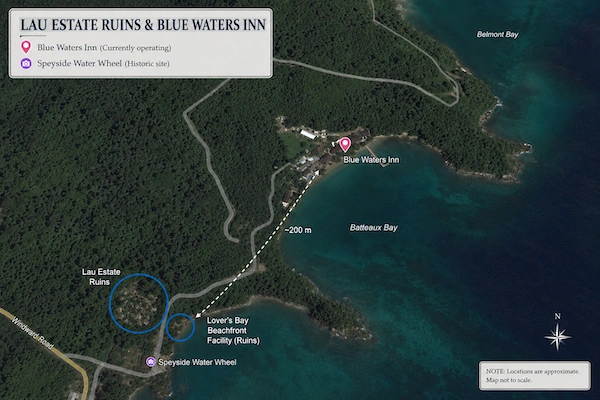
Village accounts recall that the Tucker family operated a modest guest house at Batteaux Bay which gradually expanded alongside Tobago’s growing tourism industry and eventually evolved into what is today known as Blue Waters Inn.
The property became deeply woven into village life through employment, community activities, and even sponsorship of local football teams.
Though closely associated with Speyside, members of the Tucker family were long believed by villagers to have resided primarily in Trinidad while maintaining connections to the estate.
At a later stage, Trinidadian businessman Egbert Lau acquired portions of the broader estate and continued tourism operations linked to the Bird of Paradise Inn tradition, eventually renaming the hilltop property Blue Waters Inn.
That old hilltop hotel, originally the plantation Great House which evolved into the Bird of Paradise Inn before later being renamed Blue Waters Inn, was eventually destroyed by fire following the death of Egbert Lau.
While the ruins of the waterwheel and sugar works remain visible today, only fragments of the old hilltop inn foundation survive hidden among the overgrown hillside vegetation.
The modern Blue Waters Inn was later developed closer to the beachfront below by the Kenny family.
During the 1950s and 1960s, that same lower beachfront section of the estate became associated with Camp Crusoe, operated by Bill and Ann Petry of Atlanta, Georgia, who reportedly held a 99-year lease on portions of the property from the Tucker family.
Separate from the old hilltop Bird of Paradise Inn, Camp Crusoe functioned as a more rugged youth camp and marine recreation base focused on spearfishing, snorkelling, scuba diving, and deep-sea exploration.
Permanent double cabanas were constructed along the beachfront at Batteaux Bay to house campers, counsellors, and visiting Boy Scout groups, with the camp’s coastal location providing direct access to the sea and dive boats.
Together, these ventures helped establish Speyside as one of the Caribbean’s earliest centers for boat-based scuba diving and marine exploration, laying part of the foundation for the village’s later identity as a world-renowned diving destination.
The legacy of these early tourism ventures can still be felt throughout Speyside today.
From longstanding establishments such as Blue Waters Inn and Manta Lodge to newer hotels, retreats, smaller guesthouses, dive lodges, restaurants, tour operators, and local shops, tourism remains deeply intertwined with the identity and economy of the village.
What began as a remote plantation estate gradually evolved into one of Tobago’s most distinctive tourism communities, shaped by generations of residents, entrepreneurs, fishermen, divers, and visitors drawn to the natural beauty and abundant biodiversity of Tobago’s northeastern coast.
Lau’s Legacy
Lau is remembered by some residents as an ambitious and forward-thinking figure within Tobago’s early tourism industry.
Before glass-bottom boats became commonplace, he reportedly commissioned a villager, Mr. Taylor, father of John Taylor, to construct a cedar-framed viewing box fitted with glass at the bottom. Lowered over the side of a vessel, the handmade device allowed visitors to observe coral reefs and marine life beneath the water, offering tourists an early glimpse into Speyside’s underwater world decades before such excursions became commercially commonplace.
Despite the role the Lau estate played in Speyside’s early tourism development, oral accounts from residents suggest that relations between Egbert Lau and sections of the community became increasingly strained during the social and political upheavals of the late 1960s and early 1970s.
This period coincided with the rise of the Black Power Movement in Trinidad and Tobago, part of a broader global movement that encouraged many people across the Caribbean to speak more openly about inequality, economic hardship, representation, and community rights.
Influenced by activists such as the Moheni brothers, Tuku Moheni and Embau Moheni, as well as organizations like the National Joint Action Committee, public marches and gatherings, including demonstrations in Charlotteville, helped energize many villagers across northeast Tobago and contributed to a growing sense of political consciousness within the region.
Residents recalled frustrations over inequality and exclusion.
Employment opportunities in banks and other institutions were often perceived as favouring white and lighter-skinned individuals, while many darker-skinned Tobagonians felt marginalised.
The growing Black Power Movement challenged many of these social structures and encouraged people to speak out against discrimination and economic injustice.
Within Speyside itself, disputes reportedly emerged over land use and access to parts of the estate traditionally used by villagers.
Residents complained that livestock belonging to Lau damaged crops planted by tenants and that access to sections of the beach and river became increasingly restricted.
One particularly controversial issue involved the construction of a pig pen near a river used by villagers for washing.
Lau also reportedly opposed government efforts to establish a self-help housing project in the area, despite compensation discussions taking place.
While Egbert Lau was alive, many residents viewed him as a powerful and intimidating figure who exercised strict control over the estate.
His prominence as a businessman and his perceived connections to influential figures in Trinidad contributed to a sense among villagers that he wielded considerable power and influence beyond Speyside itself.
According to oral accounts, tensions that had simmered within the community for years intensified during this period of social change and political awakening.
Over time, resentment among some villagers reportedly boiled over.
Following the death of Egbert Lau, residents tore down sections of estate fencing and set the old hilltop hotel ablaze.
In village memory, the destruction of the hotel came to symbolize more than the loss of a historic building.
For some residents, it represented a dramatic and emotional response to years of perceived injustice, exclusion, and conflict surrounding the estate.
The fire also marked the end of an era in Speyside’s tourism history, closing the chapter on the old hilltop hotel that had once overlooked the waterwheel and Batteaux Bay below.
Yet the Lau legacy extended far beyond the boundaries of Speyside Estate itself.
One of Egbert Lau’s sons, Conrad Albert “Connie” Lau, would eventually carry the family name into the world of aviation and aerospace engineering.
Born in Port of Spain in 1921 and educated at Queen’s Royal College before later attending the Massachusetts Institute of Technology (MIT), he became an aeronautical engineer during one of the most transformative periods in modern aviation history.
During his career at Chance Vought Aircraft in the United States, Conrad Lau contributed to the development of several important military aircraft, including the Corsair series and the F8U Crusader.
His work later extended into early lunar mission planning studies, including Project MALLAR (Manned Lunar Landing and Return), an influential Lunar Orbit Rendezvous concept that helped shape ideas later adopted within NASA’s Apollo program.
Though much of Connie’s life unfolded abroad, his story reflected the far-reaching paths taken by some Trinidadian families during the twentieth century, particularly within Chinese Trinidadian communities that placed strong emphasis on education, mobility, and professional advancement.
He died of cancer in 1964 at just forty-three years old, but his achievements remain one of the most remarkable branches of the broader Lau family story.
The 1979 Oil Tanker Collision
The sea surrounding Speyside has not only shaped the village through fishing and tourism, but has also placed it close to moments of international significance.
One of the most dramatic occurred on July 19, 1979, when two massive oil tankers, the SS Atlantic Empress and the Aegean Captain, collided during a severe tropical rain squall roughly eighteen miles off Tobago’s northeastern coast.
The collision resulted in one of the largest maritime disasters in history.
The Atlantic Empress would eventually become the largest ship to sink at that time, while the disaster caused what was then the largest ship-sourced oil spill ever recorded, releasing an estimated 287,000 metric tons of oil into the sea.
Residents of Speyside vividly recall the aftermath.
Thick smoke drifted across the village and, carried by the northeast trade winds, spread across much of Tobago.
Some remembered clothing left hanging on outdoor lines becoming blackened by soot, while others recalled the overwhelming smell of smoke lingering in the air for days.
One villager, travelling to Barbados on a 4-hour flight during the period, later recalled flying over the site and seeing enormous plumes of fire and smoke rising from the ocean below, an image that remained etched in memory for decades.
Despite the scale of the disaster, Speyside was largely spared the kind of environmental devastation many feared.
After burning for weeks, the tanker was eventually towed far out to sea before sinking northeast of Tobago.
Much of the high-grade crude oil burned off in the inferno or evaporated before reaching shore, helping to protect the reefs and marine life that would later become central to the village’s tourism identity.
Tragically, twenty-six crew members lost their lives in the disaster.
The Quiet Giant
Speyside is a village shaped by layers of history that still linger across its landscape.
Plantation ruins, old estate roads, village nicknames, fishing traditions, folklore, and memories passed from one generation to the next all remain woven into daily life.
Its story is not carried only in official records, but also in the voices of elders, the rhythms of village speech, the names attached to bays and communities, and the recollections of those who grew up along its coastline.
In Speyside, history is not distant.
It is lived, remembered, debated, and retold.
Today, Speyside is also home to one of its own serving as leader of the Tobago House of Assembly, Farley Augustine, who first emerged through community activism and grassroots political engagement.
In some ways, his rise echoes earlier periods of political awakening in Tobago, when figures such as the Moheni brothers encouraged Tobagonians to become more active in demanding representation, fairness, and greater control over their own affairs.
It also reflects a deeper tradition within the village itself: one shaped by strong personalities, independent thinking, and a willingness to challenge existing structures.
Though often described through its natural beauty, reefs, bird sanctuaries, and sweeping coastal views, the character of Speyside ultimately rests in its people: resilient, resourceful, independent, and deeply connected to both land and sea.
In many ways, Speyside remains true to the spirit suggested by its title: a quiet giant.
Never loud in its presence, but impossible to overlook.
References & Further Reading
- "Speyside – Tobago’s First Tourist Centre" – Dr. Rita Pemberton, Trinidad and Tobago Newsday
- Trinidad and Tobago Black Power Revolution 1970” – Tribune Magazine
- BlackPast.org
- Discover Blue Waters – Penny Strawson
- Blue Waters Inn Official Website.
- “Conrad Lau” – NIHERST Icons of Trinidad and Tobago
- “The Forgotten Plans to Reach the Moon Before Apollo” – Smithsonian Air & Space Magazine
- “The Atlantic Empress Spill” – International Tanker Owners Pollution Federation (ITOPF)
- Stony Brook University Africana Studies - Black Power Revolution in Tobago (1970)