A co-write with JC Petit, Tobago chocolatier and founder of Tobago Chocolate Delights.
When Cocoa Was King
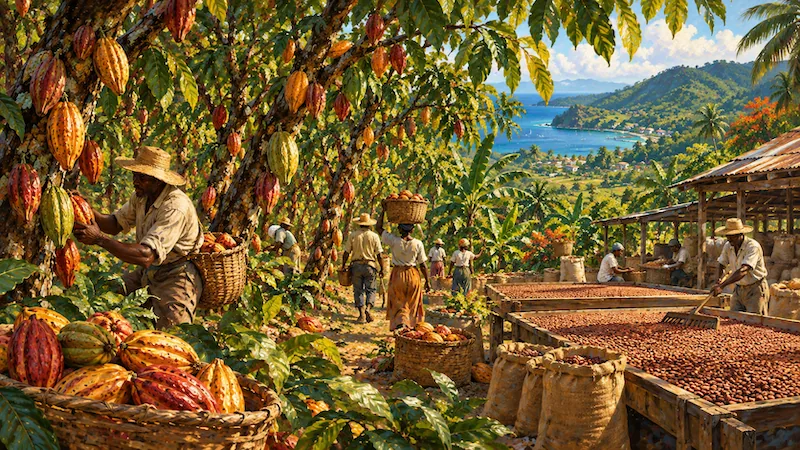
There was a time when cocoa was king.
In the late nineteenth and early twentieth centuries, cocoa estates stretched across the hills of Trinidad and Tobago in numbers difficult to imagine from the landscape today. Hillsides and valleys now associated with forest, villages and other development were once part of an agricultural world in which cocoa was everywhere.
At least it seemed that way.
At the industry's height in the 1920s, an estimated 90,000 hectares (more than 222,000 acres) of land were under cocoa cultivation. Today, that figure has fallen to roughly 3,500 hectares (about 8,650 acres). An astonishing 96% decrease.
📌 Note One metric tonne equals 1,000 kilograms, or approximately 2,205 pounds.
Production numbers tell an equally dramatic story.
In 1921, Trinidad and Tobago produced approximately 34,000 metric tonnes (nearly 75 million pounds) of cocoa. Today, annual production is measured in only a few hundred tonnes.
Estates large and small produced cocoa for a thriving export industry, and their beans would eventually help shape the flavour of chocolate around the world, particularly through the famous Trinitario variety that emerged from Trinidad.
In Tobago, the cocoa story followed its own path.
While large estates played a prominent role in Trinidad's industry, cocoa cultivation in Tobago became closely associated with small farmers who acquired plots of land and cultivated cocoa in the post-emancipation period.
As the island's sugar industry declined and former estates were abandoned, subdivided and sold, cocoa offered these farmers an opportunity to proudly earn a living from land that was their own.
In the decades that followed, cocoa became one of Tobago's most important crops.
The beans carried not only economic value, but also traditions and stories that became forever integrated into the island's culture and heritage.
The crop was not an easy one.
Cocoa trees took time to mature, farmers needed money to sustain themselves between planting and harvest, and processing beans individually could result in poorer quality and lower prices.
Co-operation offered a solution.
Farmers pooled their resources through co-operative fermentaries, where cocoa could be properly fermented and dried in larger quantities. Pembroke, Roxborough and Delaford became associated with this cooperative approach, and the fermentaries served not simply as processing centers but as gathering places within agricultural communities.
Cocoa was becoming woven into the life of Tobago.
Cocoa and the Tobago Way of Life
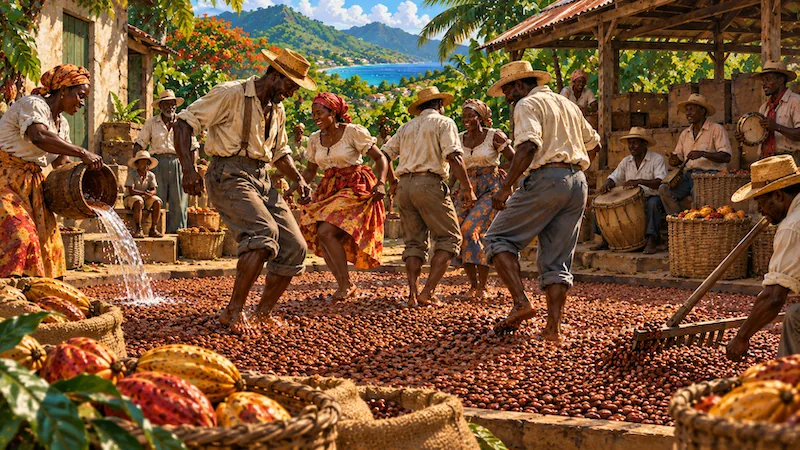
Perhaps nowhere is that relationship more vividly remembered than in the tradition known as "dancing the cocoa".
After fermentation and drying, remnants of the pulp that once surrounded the cocoa beans typically remain as a dried residue. Farmers would gather the dried beans into heaps, sprinkle them with water and have workers walk and shuffle over them. This process polished the beans and helped remove the remaining residue. Sometimes pieces of green cocoa pod, or cooking oil, were added to the water to give the beans an extra gloss.
Exactly why the green cocoa pods added that extra shine remains something of a scientific mystery.
Appearance mattered.
Shinier beans commanded a better price from buyers.
Somewhere within this practical agricultural task, work became culture.
Workers sang and moved as they polished the beans beneath their feet, giving rise to the expression dancing the cocoa.
What began as part of preparing cocoa for market eventually became part of Tobago's cultural memory.
Cocoa also entered the rhythm of the calendar.
Farmers were paid an initial assessed value when they delivered their cocoa to the co-operative fermentary. Once the combined crop had been processed and sold and its final value determined, they received an additional payment popularly known as the cocoa cess. That final payment was traditionally distributed in December, tying the rewards of the cocoa harvest to Christmas celebrations across Tobago.
Cocoa, then, was more than a bean destined for export.
It helped shape livelihoods, communities, traditions and memories.
A Bean Born of Trinidad and Tobago
The story becomes even more remarkable when we consider the cocoa itself.
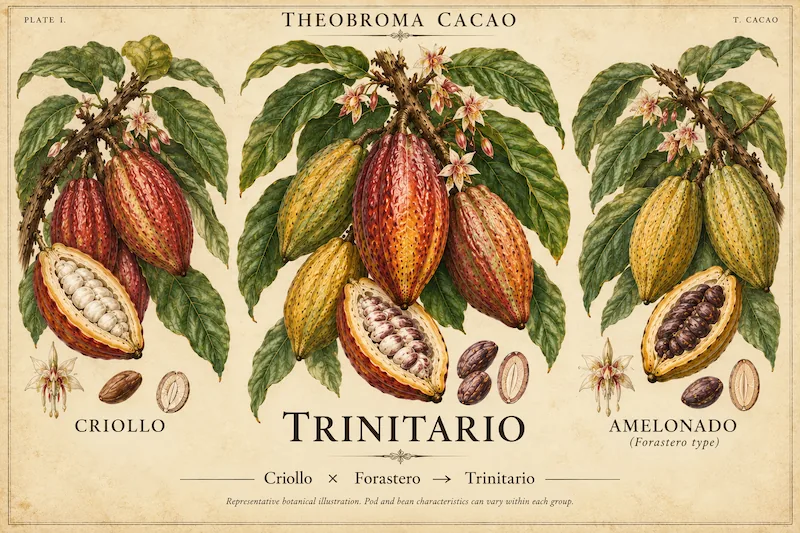
Three names regularly appear in discussions of the world's cocoa: Criollo, Forastero and Trinitario.
Criollo is highly flavourful but relatively vulnerable to disease.
Forastero, by contrast, became widely cultivated because of its hardiness and productivity, although its flavour is generally less delicate.
Trinitario brought those characteristics of the two together.
Its emergence is intimately connected to Trinidad.
In the 1720s, Trinidad's flourishing Criollo cocoa industry suffered a catastrophic collapse: an event that would later become known as the Blast.
Exactly what happened has never fully been agreed upon, and the truth seems largely lost to time.
Disease, drought, hurricanes and other explanations have all been proposed over the years. Modern research suggests there may never have been a single "Blast" at all. Instead, the vulnerability of Criollo cocoa, agricultural conditions and unusual climatic conditions during the period may have combined to devastate the crop.
Even the traditional date of 1727 has been questioned, with earlier historical records placing 'a' catastrophe in 1725.
In the years that followed, the more resilient Forastero cocoa was introduced into Trinidad and eventually crossed naturally with surviving Criollo trees.
From that fortuitous crossing emerged something extraordinary: Trinitario
Believe it or not, remarkably, no one had set out to purposefully create it.
Trinitario emerged by chance, through the natural crossing of Forastero and surviving Criollo trees.
This history matters enormously.
Trinidad and Tobago did not simply grow cocoa.
The country became an important center of cocoa development and research, with much of that research centered in Trinidad. As Trinidad's cocoa industry developed, researchers began seeking varieties with improved resistance to disease while retaining the qualities for which Trinitario had become prized.
The results of that research would eventually travel far beyond Trinidad and Tobago.
Cocoa selections produced through this research became an integral part of growing and breeding programs across the Caribbean, Latin America, Africa, Asia and the Pacific. Among them were the Imperial College Selections (ICS), specially selected cocoa clones that still thrive in countries such as Jamaica, Venezuela, Ecuador, Cameroon, Sri Lanka, Samoa and Papua New Guinea.
Today, Trinidad and Tobago's fine-flavour cocoa enjoys an enviable international reputation.
And flavour is not simply a matter of variety.
Cocoa takes on characteristics from the soil and surrounding vegetation in which it is grown, giving beans from different growing environments their own distinctive qualities.
The result can be a remarkable range of flavours from one location to another...
...a chocolate expression of place.
When Cocoa Lost Its Crown
Yet the golden age could not last.
Cocoa faced a combination of pressures rather than a single fatal blow.
Disease reduced yields and made estates increasingly difficult and costly to maintain. International cocoa prices swung unpredictably, adding yet another layer of uncertainty to an industry already buckling.
Agricultural labour became harder to secure as the cocoa industry found itself competing for workers with Trinidad and Tobago's growing petroleum economy, which offered the prospect of better wages and a more reliable livelihood.
Tobago, however, faced another significant life-changing catastrophe.
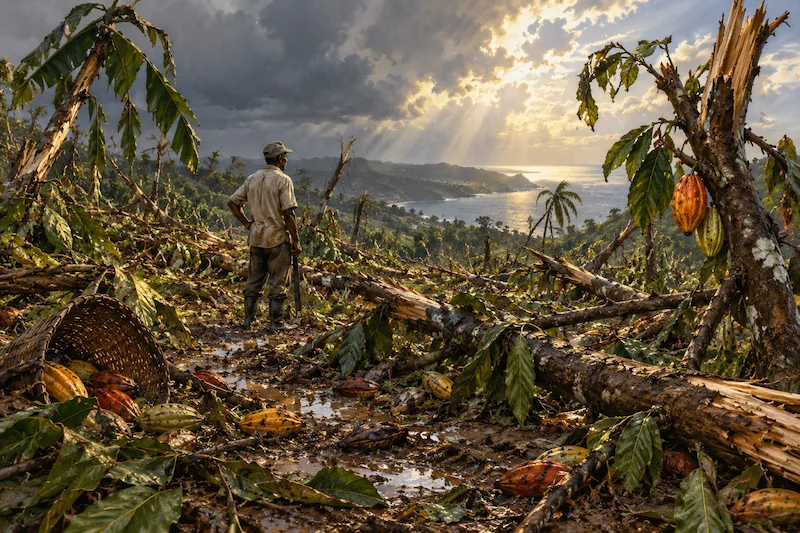
In 1963, Hurricane Flora tore across the island, devastating agriculture and destroying a significant portion of her tree crops. Cocoa trees were uprooted, gardens ravaged, and the destruction further eroded the resolve of an older generation of farmers already confronting the everyday difficulties of agricultural life.
Even before Flora, younger Tobagonians, seeing the struggles faced by the older generation of farmers, were increasingly looking beyond agriculture for their livelihoods. In the hurricane's aftermath, government reconstruction projects offered new forms of employment, further accelerating that shift.
Cocoa never entirely disappeared.
But the world in which cocoa had once been king was changing, and Hurricane Flora dealt it a devastating blow.
The Paradox of Tobago Cocoa
Today, a curious contradiction lies at the center of Tobago's cocoa story.
This is an island with a long cocoa heritage, belonging to a country internationally known for its fine-flavour cocoa.
It has the history.
It has the climate.
It has the knowledge.
But what it conspicuously lacks is the cocoa itself.
Cocoa is still being grown in scattered pockets across Tobago, but only limited quantities of those beans find their way into the local market. Some growers retain their beans for their own use, while others sell small amounts to people who continue the island's tradition of making cocoa balls for cocoa tea.
For Tobago's chocolate makers, however, obtaining a reliable supply of locally grown beans remains a significant challenge.
That already limited supply must satisfy competing demands.
Beans destined for chocolate production compete with those used to make the cocoa balls essential to the island's beloved cocoa tea.
...and make no mistake, Tobagonians are unapologetically serious about their cocoa tea.
With so little locally grown cocoa reaching the market, there is simply not enough to satisfy both.
The result is a remarkable contradiction.
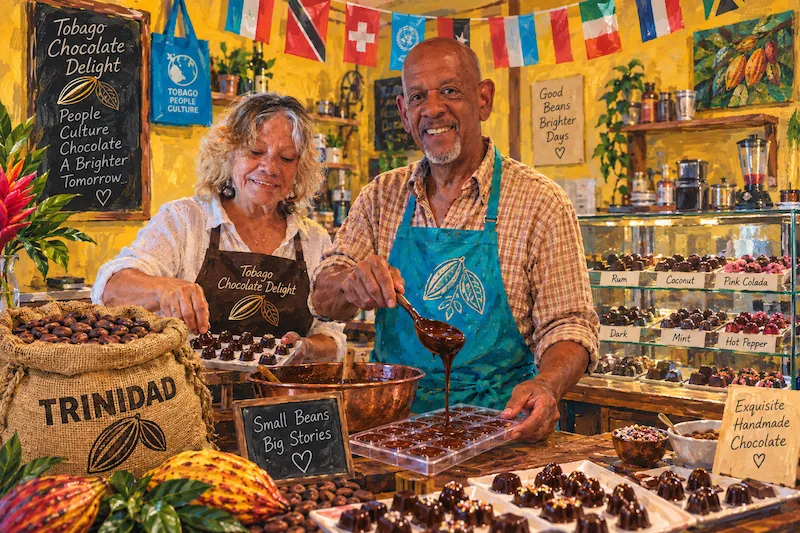
Despite making chocolate locally in Tobago, bean-to-bar chocolate enterprise Tobago Chocolate Delights is currently forced to obtain approximately 90% of its cocoa beans from Trinidad.
An island once shaped by cocoa now struggles to supply the very beans needed to make chocolate on the island itself.
For Tobago's remaining cocoa farmers, the challenges are considerable.
Labour is difficult to find, a changing climate presents new pressures, and the financing needed to establish, maintain and expand cocoa cultivation is just about impossible to secure.
Then there is the question of organization: the challenge of strengthening the networks needed to support cocoa farmers.
More than fifteen years ago, Tobago's own cocoa policy called for increased production, the rehabilitation of former cocoa lands, greater access to financing and labour, stronger farmer co-operatives and associations, and the development of value-added cocoa products linked to tourism.
Although many of those ambitions have yet to be fully realized, efforts to pursue some of them can already be seen across Tobago.
But the paradox also points toward an opportunity.
The answer does not have to be the recreation of Tobago's cocoa industry as it existed a century ago.
The world has changed.
Tobago has changed.
The more interesting question is what Tobago could do with cocoa now.
Heritage and Possibility
The possibilities for cocoa's future in Tobago are excitingly considerable.
The island already possesses many of the ingredients needed to build something distinctive from that inheritance.
Its history, fine-flavour cocoa heritage, natural beauty and established tourism industry create opportunities that extend far beyond simply growing beans for export.
Ecotourism, distinctly Tobago-branded chocolate and expanded uses for cocoa, from culinary products to cosmetics, all offer potential paths forward.
In fact, some of those possibilities are already being explored.
In the hills above Roxborough, Duane Dove's Tobago Cocoa Estate is among the pioneering ventures in cocoa's modern revival on the island. Established in the mid-2000s on part of the former Roxborough cocoa estate, Dove set about rehabilitating cocoa lands and cultivating fine-flavour cocoa, while incorporating agro-tourism into the venture. Visitors have been able to experience the estate and learn about cocoa production, while Tobago Cocoa Estate's chocolate has carried the island's name into international markets and earned international awards.
In the village of Plymouth, Randy and Carlina Taylor of Tonči Chocolates & Coffee have developed a small tree-to-bar operation using Tobago-grown cocoa. Their search for local beans has taken them beyond established cocoa farmers to Tobagonians with just a few cocoa trees growing on their land, buying what they can find during the season and paying a premium for locally grown beans. They have also opened their operation to visitors, offering an experience that brings cocoa, chocolate and another of Tobago's traditional crops, coffee, together.
At the other end of the scale, an ambitious cocoa rehabilitation initiative is underway in Charlotteville, where the Trinidad and Tobago Fine Cocoa Company has announced plans to return as much as 1,000 acres of dormant land to cocoa cultivation. Supported by a wider effort to attract sustainable investment into Trinidad and Tobago's cocoa sector, including some European Union funding, the initiative is part of a growing attempt to bring abandoned cocoa lands back into production. The project envisions bringing together cocoa production with training, community development and agro-tourism, while work is also underway to restore Charlotteville's historic cocoa house and its rolling roof.
Led by Ashley Parasram, founder and director of the Trinidad and Tobago Fine Cocoa Company, the initiative also extends beyond the cocoa field, with a new chocolate lab at the Tobago Hospitality and Tourism Institute nearing completion. The facility is intended to provide chocolate-making training and international exchanges while developing local expertise in cocoa and Tobago's own flavours.
Tobago does not need to compete with the enormous cocoa-producing countries of the world on quantity.
Imagine the cocoa experience as part of Tobago itself.
A visitor walks beneath cocoa trees and sees the brightly coloured pods growing directly from trunks and branches.
They learn how generations of Tobago's cocoa farmers cultivated the crop and how co-operative fermentaries became part of the life of cocoa-growing communities.
They discover how the work of cleaning and polishing cocoa became dancing the cocoa, with song and movement transforming an agricultural task into a treasured Tobago tradition.
They break open a ripe cocoa pod for the first time and discover something entirely unexpected.
Nothing inside looks much like chocolate.
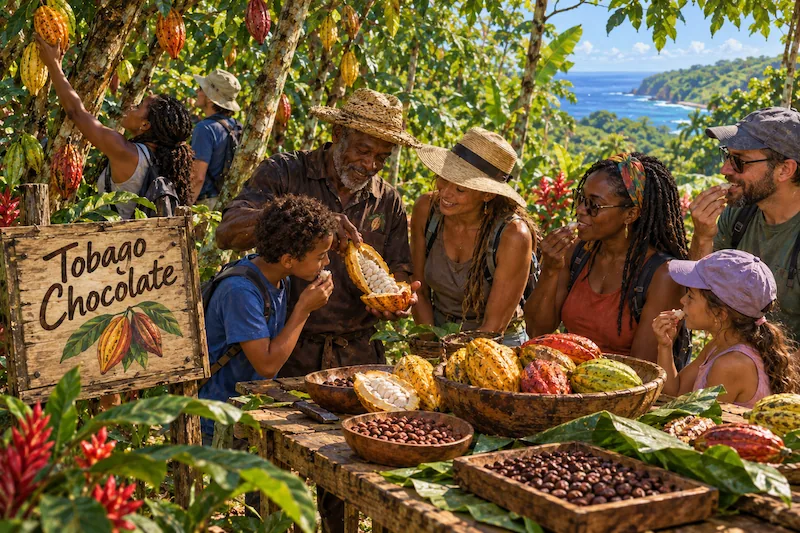
Instead, nestled within the brightly coloured pod are rows of beans covered in a soft, white pulp. They taste it and encounter another surprise. The pulp is sweet and fruity, its flavour and texture seemingly worlds away from the chocolate those strange-looking beans will eventually become.
Then they follow the transformation.
They watch as the beans are fermented, spread beneath the tropical sun to dry, and finally roasted, when the familiar aroma of chocolate begins to emerge.
And then comes the reward.
They taste the finished Tobago chocolate, perhaps flavoured with coconut, mango, passion fruit or another ingredient grown on the island.
What began as an unfamiliar white pulp-covered bean has become something almost everyone recognizes.
Chocolate
Agriculture becomes history.
History becomes culture.
Culture becomes an experience.
A carnival of sights, discovery and flavour.
Experiences such as these could allow Tobago to benefit from the international interest in craft chocolate and fine-flavour cocoa, while sharing its uniqueness with the world.
The question is not whether the island possesses something valuable.
She clearly does.
The deeper question is what an island chooses to do with an inheritance that history has placed in its hands.
The story does not have to be one of an industry that failed.
It can be the story of an inheritance reclaimed.
There was a time when cocoa was king.
But Tobago does not need to recreate that world.
The island of today has a different economy, different communities and different opportunities.
Perhaps cocoa's success should be measured differently.
In the farmer who decides that fine-flavour cocoa is worth cultivating.
In the visitor who discovers that chocolate begins with a fruit growing beneath a tropical canopy.
In the chocolatier who transforms Tobago's cocoa and flavours into something that could have been created nowhere else.
And in the preservation and celebration of a story that might otherwise slowly disappear from the island's collective memory.
Its greatest days need not belong only to its past.
The possibility lies in what Tobago chooses to make of it next.
And perhaps the next chapter is one you can experience for yourself.
If you find yourself in Charlotteville during Tobago's annual Heritage Festival in July, you may even witness Dancing the Cocoa, as an old agricultural tradition comes alive once again as part of the village's Natural Treasures Day.
About the Collaborator
Jean Claude "JC" Petit is the founder of Tobago Chocolate Delights and a pioneer of small-scale bean-to-bar chocolate making in Tobago.
His journey to chocolate was anything but conventional. A petroleum geologist, teacher, community development professional and entrepreneur, Petit fell in love with the chocolate-making process during a visit to a chocolate factory in Daytona Beach, Florida, leaving with the conviction that one day he would own a chocolate shop of his own where his own ideas would come to life.
He later studied chocolate making in Orlando before returning to Tobago, where a meeting with Clement Bobb, then president of the Tobago Cocoa Farmers Association, drew him deeper into the island's cocoa heritage. His research and experimentation eventually gave birth to Tobago Chocolate Delights.
Tobago Chocolate Delights is located at Shore Things Café & Craft in Lambeau, a charming seaside breakfast and lunch café and craft shop overlooking the Atlantic Ocean. There, you can find JC and his wife Greta in their small, cozy chocolate shop, discover their handmade chocolates and experience the chocolate-making process for yourself.
References & Further Reading
- "The History of Cocoa Production in Trinidad and Tobago" – Cocoa Research Unit, The University of the West Indies
- "When Cocoa Was King in Tobago" – Dr. Rita Pemberton, Trinidad and Tobago Newsday
- "The Cocoa Industry: Trinidad and Tobago Cocoa (Cacao)" – National Library and Information System Authority (NALIS)
- "Revisiting 1727: Crop Failure Leads to the Birth of Trinitario Cacao" – Lambert A. Motilal and Thayil N. Sreenivasan, Journal of Crop Improvement
- "Creating a Chocolate Brand for T&T" – UWI Today, The University of the West Indies
- "Journey to Destination Chocolate" – Trinidad and Tobago Newsday
- "Charlotteville Alive for Natural Treasures Day" – Trinidad and Tobago Newsday
- "Reviving Tobago's Cocoa for a Sustainable Future" – Trinidad and Tobago Fine Cocoa Company
- Tobago Cocoa Estate – Official Website
- Tonči Chocolates & Coffee – Official Website